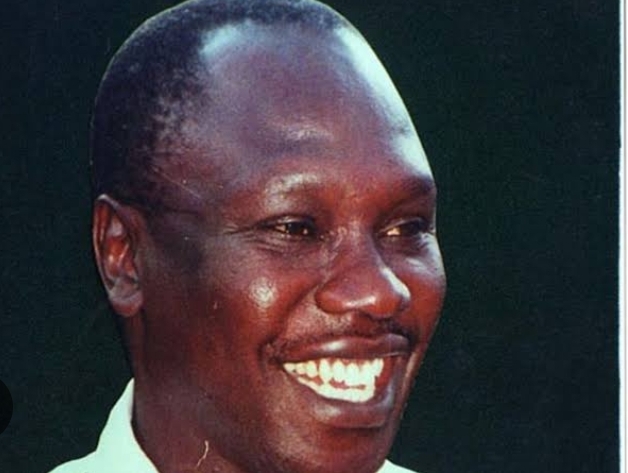
A few days ago, I saw someone talking about Heroes Day and mentioned Dr. Lukwiya among them. It made me realise that most of us know him simply as the doctor who died treating Ebola patients at Lacor Hospital in 2000, and not much else.
I felt slightly guilty for not knowing more about a man who seems to transcend history, so I went looking for the full story of Dr. Matthew Lukwiya. What I found was a man who had spent the twenty years before Ebola practising exactly the kind of courage that the outbreak would eventually demand of him.
This is what many of us didn’t know about Dr. Matthew, as he was lovingly called.
He was born in Kitgum to a fishmonger father who drowned when Matthew was twelve, and a mother who survived by smuggling tea across the Sudanese border to trade for soap. She tried to teach him the same trade, balancing goods on a bicycle through the bush, but he had other ideas. He topped his primary class, and then he was the best in the country in national exams. The same boy his mother had been training to smuggle goods was about to smuggle himself out of poverty entirely, through a series of scholarships that took him all the way to Makerere University Medical Faculty.
In 1983, he arrived at St. Mary’s Hospital Lacor, a Catholic missionary hospital outside Gulu, as one of the very first medical interns under a new programme that allowed newly graduated doctors to train there. It took the founders, Dr. Piero Corti and Dr. Lucille Teasdale-Corti, just three months to decide that this young intern was going to be the one to inherit everything they had built. Dr. Corti’s official report on Matthew’s probation period read like a prophecy: after a long list of “outstanding” and “above average” marks, his final comment was simply that “the marks given are self-explanatory. Dr. Lukwiya will soon make an outstanding physician.”
Then came the LRA war.
The Lord’s Resistance Army was everywhere in Acholiland, and St. Mary’s was on its map. The rebels looted regularly. They abducted nurses for ransom in money and drugs. On Good Friday 1989, the rebels came to the hospital intending to take several Italian nuns. With the Cortis temporarily away, Matthew, then Deputy Medical Superintendent, took responsibility as head of the hospital and negotiated with the rebels. He offered that they take him instead. He walked into the bush in his physician’s gown and spent a week being marched around by armed men before they let him go. When the Cortis rushed back and heard what had happened, they decided the staff could no longer be expected to work under such conditions and prepared to close the hospital. It took several tense days of negotiation before the rebels promised never to enter Lacor again. They kept that promise. The hospital remained open.
Matthew then opened the gates to anyone in the surrounding villages who needed somewhere to sleep, safe from the rampant abductions. At one point, nine thousand people, most of them children, were walking in from the bush every evening, sleeping on the hospital grounds every single night. The hospital had effectively become a refuge being run by a man who had decided long ago that his life was a resource for other people. One night, a mortar shell came through the ceiling of his family home while he, his wife Margaret, and their five children were lying in bed listening to the gunfire outside. The shell failed to explode, and they survived.
In 1991, exhausted from the workload, he was sent on a Corti-arranged sponsorship to the Liverpool School of Tropical Medicine to pursue a Master’s in Tropical Paediatrics. There, he got the highest marks in the school’s history and won the John Hay Prize. Professor Coulter, his supervisor, would later write that Matthew “was an outstanding student and his wide experience contributed enormously to the course.”
Liverpool offered him a teaching position on the spot, which would have meant a comfortable life in England, a great salary, his children in good schools, and distance from a war that had already tried to kill him twice, but guess what!
He turned it down and came back to Lacor Hospital. He became Medical Superintendent in 1997. Under his leadership over the next decade, the hospital tripled its capacity to 18,000 patients a year, treated wounded Ugandans from both sides of the war without asking questions, and became arguably the best hospital in Uganda and one of the finest in East Africa. The man who could have built a great academic career in Liverpool kept choosing Gulu.
When Ebola arrived in October 2000, he did what he always did. He showed up.
He was in Kampala finishing a Master’s in Public Health when Lacor Hospital called. Three nursing students had died of a mysterious illness. He returned the same day. By the next morning, he had reviewed every unusual case in the past two weeks, identified seventeen with similar symptoms, and concluded, before any official test, that this was a viral haemorrhagic fever, probably Ebola. He bypassed every bureaucratic protocol that would have wasted days. He picked up the phone, called Kampala directly, and spoke to Dr. Sam Okware, the Commissioner of Community Health Services. That phone call, made days before government would have otherwise known, is what foreign epidemiologists later credited with saving hundreds, possibly thousands of Ugandan lives.
When the WHO team arrived, expecting the chaos and abandonment they had seen in Kikwit, DRC, five years earlier, they were stunned. Lukwiya had already organised volunteer nursing, surveillance, and burial teams, set up a fully functioning isolation ward operating to international standards, and arranged ambulance crews to bring patients from villages and collect bodies for safe burial. There was even a small wooden device for pulling off rubber boots, built exactly as the WHO manual specified, by a Lacor staff member who had read the manual the night before. The WHO and Médecins Sans Frontières teams redirected to Gulu Regional Referral Hospital instead, where they found corpses abandoned in beds.
For weeks, he worked from 7am to 8pm every single day inside the isolation ward, in protective gear designed for temperate climates being worn under the equatorial sun. Twelve health workers had already died. When the nurses finally broke and threatened to walk out, four hundred of them, nearly the entire staff of the hospital, gathered in the nursing school assembly hall and demanded the hospital be closed.
Lukwiya rushed down and stood in front of them. He reminded them of Good Friday 1989, when he had walked into the bush in place of the nuns. He told them that if they closed the hospital, he was leaving Gulu and never coming back, and that the deaths that followed would be on them. Then, after hours of arguing, he softened entirely and said he would remain even if every single one of them left. The meeting ended with him and the nurses singing a hymn together. The hospital stayed open.
The cause of his own infection is no longer a mystery. According to the Lacor Hospital obituary, on the night of November 20th he was called to restrain a critically ill nurse, Simon Ajok, who had become confused, was coughing and vomiting blood profusely, and had pulled off his oxygen mask. Lukwiya put on protective clothing as usual, but did not put on the goggles. As he tried to lift the patient, his sleeve became contaminated with Ajok’s blood. The infectiousness of the secretions that night was so extreme that Lukwiya and two other nurses were all infected. Ajok died an hour later.
Six days later, Lukwiya told the staff plainly, “People, I am not well. I need to be away from you.” He isolated himself in his house. Colleagues went to check on him, and within a week, his condition had worsened so much that they prepared a room for him in the ward. His blood sample was sent to the CDC, and the result came back positive.
A nurse administering his drip at home one evening overheard him speaking quietly, not to her, but to someone she could not see. He said, “Oh God, I think I will die in my service. If I die, let me be the last.” Then, in a clear voice, he sang Onward, Christian Soldiers. When the official diagnosis came, he asked to be moved into the isolation ward himself. He said, “Since I am the boss, I should show an example.” He was placed in the same ward where so many of his nurses had already died, treated by the same protocols he had personally written.
Margaret was allowed to come on December 1st, kept three feet from his bed throughout. The closest she got to her husband in his final days was being permitted to touch his foot through three layers of glove. She would put on full protective gear, sit with him for five minutes, pray with him, and leave.
In his final hours, he spoke to Sister Apio Anyai Angioletta, the paediatric nurse who had known him for years. She would later remember his exact words. “Sister, things are worsening. I have tried to fight. The battle is almost over. Now I am seeing that I am also going. The time has come for me to go. That I know. I am going. But if I go, I will be at the doorway. Nobody is going to die now. I will tell my God that enough is enough.”
Then he began to sing a hymn about war. Everyone in the room broke down. Sister Apio replied, “No, doctor, it will not be like that.” But it was. On December 4th his breathing briefly stabilised. Later that evening his lungs began to haemorrhage. He died at 1:20am on December 5th, 2000.
He was buried at 4pm the same day. The coffin was sprayed with Jik bleach as it was lowered. Margaret asked if she could see him one last time and was refused. The body was considered too infectious.
He was placed in a grave he had chosen himself while he was dying, at the Grotto inside the hospital grounds, beside Dr. Lucille Teasdale and later Piero Corti. Teasdale had died in 1996 of AIDS, contracted while operating on an HIV-positive patient. The student was buried beside his mentors.
And then something extraordinary happened. After Lukwiya’s death, every remaining Ebola patient at Lacor survived. Not another single person died at the hospital. Sister Apio remembered the promise he had made on his deathbed: “I will tell my God that enough is enough.” It is the kind of detail you would not believe if you read it in a novel.
By the time the WHO declared Uganda Ebola-free on February 6th, 2001, 425 confirmed and probable cases had been recorded, and 224 Ugandans had died, including thirteen health workers from Lacor alone.
The survival rate during the outbreak was nearly 50%, compared to as low as 10% in previous African outbreaks, largely because of the systems Lukwiya had built before anyone else even knew what was happening.
This is what the mainstream story leaves out. The intern who refused a teaching job in England. The doctor who walked into the bush instead of the nuns. The administrator who turned the hospital into a shelter for nine thousand people, most of them children, every night.
The Acholi son of a smuggler who topped his country in school, won the John Hay Prize at Liverpool, and still chose Gulu over everything else. By the time he made that final speech to his nurses, the heroism was already the entire shape of his life. The Ebola work only made it public.
Happy Heroes Day, Dr Matthew and all healthcare workers who sacrifice more than they should have to!