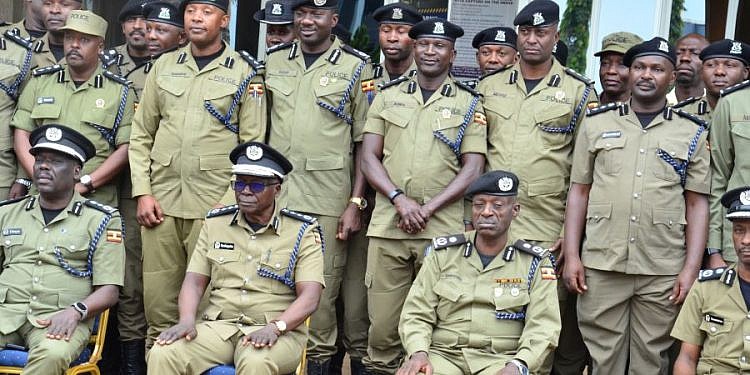
The Inspector General of Police, Abas Byakagaba, has cautioned police commanders against making unlawful arrests and unnecessarily detaining suspects , warning that such practices violate citizens’ rights, undermine public confidence and drain the force’s financial resources.
Byakagaba said police officers must change their approach to law enforcement and stop treating arrests and detention as the default response to every suspected offence, urging commanders to ensure that all actions are guided by the law and respect for due process.
Addressing senior police commanders at Police headquarters in Naguru, the IGP said the police mandate is to investigate offences and process suspects in accordance with the law, rather than punish individuals.
He challenged officers to consider alternative lawful procedures, such as summoning suspects to record statements or appear in court, instead of automatically placing them in police cells.
“There are many cases where we don’t necessarily need to detain, but you find we are busy detaining. Why are you detaining me? Why don’t you summon me? First of all, maybe I need to make a statement, and then I go home. Then also summon me to appear in court if you feel it is necessary for me to appear in court,” Byakagaba said.
He criticised what he described as an entrenched mentality among some officers, where detention is considered a demonstration of authority, regardless of whether it is necessary or legally justified.
The Police Chief insisted that officers must understand that arrest and detention are not forms of punishment and should never be used to intimidate citizens or settle personal interests.
“Police is not in that category of punishing. The police is in the process of processing for the other side to look at the situation. It is not within our mandate,” he emphasised.
Unnecessary detention
Byakagaba said unnecessary detention also carries significant financial implications for the Uganda Police Force, explaining that every person held in police custody requires food, security and other basic necessities.
He challenged commanders to appreciate the cumulative cost of unnecessary detention across police stations and districts, saying decisions that may appear insignificant at an individual station can create a substantial financial burden when replicated throughout the country.
“When you detain someone who doesn’t deserve to be inside the cells, you are using police resources. Tomorrow again you are asking for fuel, but you have made someone who doesn’t deserve to be inside to be there for other people’s interests,” he said.
He explained that commanders often concentrate on the immediate operations of their respective units without considering how their decisions affect the overall financial position of the force.
Byakagaba gave an example of different officers across the country making unnecessary detention decisions, noting that the combined cost of maintaining such detainees could deprive the police of resources needed for other critical operations.
“You will be looking at your own unit. But another commander is in Soroti detaining, another one is in Iganga, another one is in Kisoro, when actually there shouldn’t be that detention. When you add the total, there is a very serious implication on the resources of the force,” he observed.
He urged officers to make decisions that protect both citizens’ rights and the institution’s resources.
The IGP also warned that unlawful arrests, detention and the continued impounding of vehicles were exposing the force to legal challenges, with affected individuals increasingly taking police officers and the institution to court.
He particularly criticised the practice of impounding vehicles and keeping them for extended periods until they deteriorate, sometimes without sufficient legal justification.
“Even detaining vehicles until they become scrap is something we must think about. I also want to share with you that the force is beginning to pay. When you do it illegally, people are taking us also to court,” Byakagaba warned.
He urged commanders to discuss actual cases in which police actions had resulted in litigation and draw lessons to prevent similar incidents.
He said officers must understand that the authority they exercise is not personal but is delegated by the government and the people of Uganda.
“There is a lot of authority, but it is not our personal authority. It is the authority of the government. It is the authority of the people of Uganda. It is delegated authority, and we must pick it from the books and apply it judiciously,” he said.
Byakagaba added that officers who follow the correct procedures protect the image of the force while saving public resources.
“Even if someone, even if it is only you individually, do the right processes and leave that person. He or she will be punished, by the way, if there is a case. But through due process. When you do the right things properly, there is a saving. A saving in image, a saving even in real money,” he said.
The Police Chief challenged commanders to change the way they manage police operations, saying the force must embrace professionalism, accountability and respect for the rights of the people it serves.
He said police authority should be exercised strictly within the law and for the benefit of citizens, rather than being used to intimidate or inconvenience them.
“These are just a few examples, and we need to continue being smart, but we must keep remembering that this is service to the people,” he said.
He further urged officers to appreciate the consequences of their actions, particularly where decisions involving arrests, detention and investigations affect the public’s perception of the institution.
The IGP said the force must continuously improve its internal systems and operational procedures to match changing policing demands.
He also cautioned officers against ignoring established processes in recruitment, training and personnel management, arguing that institutional failures at one stage can affect the integrity and performance of the entire force.
“Garbage in, garbage out. You want to get results from garbage, and that means you will get a stench. You can’t get a sweet-smelling odour from garbage,” he said.
Byakagaba explained that cases of police officers engaging in criminal conduct could partly reflect failures in recruitment, training or management.
“Some of us get involved in criminality because, at the beginning, we did not recruit right. Or if we recruited right, that means we did not train right. If we trained right, that means we did not manage right,” he observed.
He urged police managers to take responsibility for strengthening institutional processes and ensuring that officers uphold the highest standards of conduct.
The IGP also emphasised the importance of improving police officers’ welfare, describing human resources as the force’s most important asset.
He said police management had agreed to reprioritise the force’s budget to address officers’ basic welfare needs, including uniforms, feeding, accommodation and other essential requirements.
“The biggest resource that we have is the human resource. The non-human resource follows after. So the real critical resource is the human resource, including all ourselves,” he said.
He urged commanders to ensure that officers under their supervision are properly equipped, prepared and motivated to execute their responsibilities.
“Even when we have all the force multipliers, even when we have all the best equipment and weapons, the critical one is that human resource,” he said.
Byakagaba further reminded officers that policing requires commitment and sacrifice, given the responsibility of protecting lives and property.
He cited the recent death of a police officer who was killed while responding to a reported robbery in Kiruhura District, asking the meeting to observe a minute of silence in honour of the fallen officer.
He said police personnel must remain committed to their responsibilities, describing patriotism as a willingness to make sacrifices in service to the country.
“A patriot, in my little definition, is someone who is ready to die a little. That means extra sacrifice,” he said.
The IGP’s remarks underline his call for a more professional, accountable and preventive approach to policing, with commanders expected to ensure that officers exercise their powers lawfully while protecting the rights, dignity and interests of Ugandans.