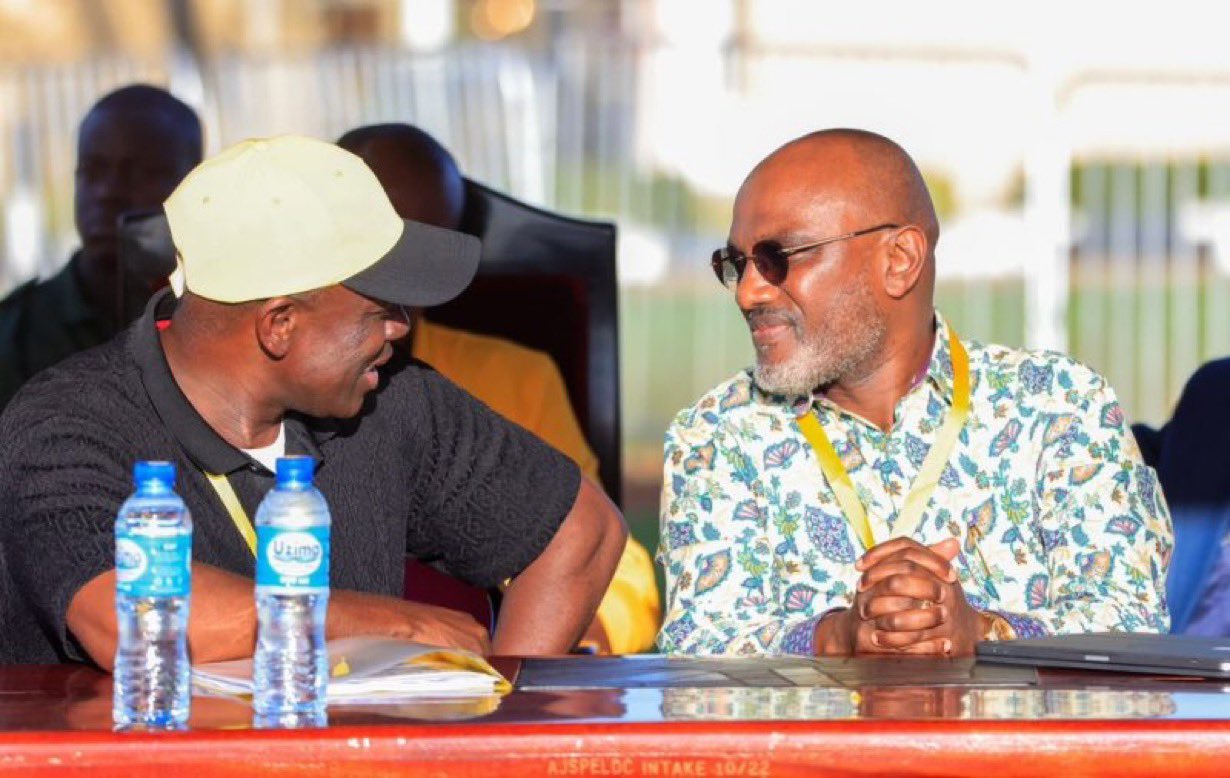
Uganda must firmly resist being pulled into global ideological rivalries and instead deploy disciplined, interest-driven diplomacy to unlock investment, markets and technology needed for rapid economic transformation, Ambassador Adonia Ayebare told senior National Resistance Movement leaders.
In a forceful presentation at the Kyankwanzi retreat, Ayebare cautioned that the global order is increasingly defined by “ideological brinkmanship”, a high-risk strategy where states push confrontation to the edge to extract concessions, but warned that such positioning would be costly for a developing economy like Uganda.
“The greatest danger of ideological brinkmanship is not only external rivalry. It is allowing external rivalry to set Uganda’s agenda and development priorities,” Ayebare said.
“When diplomatic bandwidth is consumed by ideological signaling, countries can lose focus on execution, export readiness, investor aftercare, infrastructure coordination, skills formation, and domestic institutional credibility.”
Ayebare’s warning reflects a broader concern among Global South countries that the current geopolitical climate is reviving pressures reminiscent of the Cold War, where nations were compelled to align with competing blocs.
Uganda’s recent voting patterns at the United Nations, including abstentions on divisive global conflicts, illustrate this approach, aimed at preserving policy flexibility while maintaining relations with all major partners.
Ayebare framed Uganda’s foreign policy within the constitutional principles of national interest, peaceful coexistence and non-alignment, arguing that these are not passive ideals but active tools for economic advancement.
“Strategic diplomacy is the intentional, calculated, long-term deployment of diplomatic tools to advance national interests, shape global agendas and manage complex international relationships,” he said.
“Uganda has a strong, practical case for strategic diplomacy grounded in our geography, security role, and economic ambitions.” He stressed that foreign policy must now be judged not by rhetoric, but by measurable economic outcomes.
“Strategic diplomacy must serve transformation, not theatrics. Foreign policy should be assessed on whether it builds a larger productive economy, widens market access, attracts quality investment and creates jobs.”
Ayebare urged leaders to rethink Uganda’s geography as a strategic advantage rather than a constraint, describing the country as “land-linked, not landlocked.”
“Geostrategy is how a country’s geographic factors influence its political and military strategy to gain advantage,” he said, noting Uganda’s position at the intersection of the Great Lakes and Horn of Africa regions.
This reflects a growing recognition within government that foreign policy is no longer just about political relations, but a primary tool for securing investment, technology, and market access.
“Rather than reacting to events, Uganda can use diplomacy to shape regional outcomes, attract long-term investment and make strategic decisions owing to its geography,” said Ayebare.
He pointed to Uganda’s involvement in major regional infrastructure and energy projects, including the East African Crude Oil Pipeline and emerging transport corridors, as evidence of diplomacy translating into economic positioning.
Security Role
Ayebare underscored Uganda’s military footprint across Africa as a key pillar of its diplomatic weight, particularly its leading role in stabilisation missions in Somalia and the wider region. “These contributions strengthen Uganda’s diplomatic influence and credibility regionally and globally,” he said.
He added that Uganda’s hosting of the United Nations Regional Service Centre in Entebbe, which supports the majority of global peacekeeping operations, is a “testament to the important role Uganda plays in the maintenance of international peace and security.”
Ayebare delivered one of his strongest warnings against alignment politics, arguing that Uganda must not be forced into choosing sides among competing global powers.
“Uganda should avoid being drawn into ideological brinkmanship that forces binary alignments in great-power competition. “Uganda’s overriding diplomatic doctrine should be principled non-alignment with active engagement.”
He added that Uganda’s approach to partners such as China, the United States and Russia has been most effective when guided strictly by national interest.
“That means maintaining constructive relations across competing power centers while judging partnerships by whether they advance Uganda’s transformation objectives — value addition, industrial upgrading, infrastructure, energy development, skills and export diversification.”
Capital, Markets
Ayebare laid out a comprehensive economic diplomacy framework anchored on market expansion, investment attraction, value addition, financial partnerships, and technology transfer.
“The objective is not diplomatic balance for its own sake; it is to secure capital, technology and industrial partnerships,” he said, warning that ideological signaling could deter investors.
On trade, he highlighted a structural shift in global commerce toward developing economies. “More than half of Africa’s merchandise exports now go to other developing countries,” Ayebare said, urging deeper engagement with regional blocs such as the East African Community and the African Continental Free Trade Area, as well as markets in Asia and the Middle East.
On industrialisation, he called for diplomacy that actively supports value addition. “Diplomacy must support standards compliance, industrial partnerships, logistics and trade finance,” he said. “Uganda must produce more middle-to-high export products from its domestic raw materials.”
Ayebare pointed to Uganda’s leadership roles in the Non-Aligned Movement and the Group of 77 and China as platforms to advance the interests of developing countries.
“Uganda should build on this reputation as a constructive Global South actor and leader,” he said. He urged Uganda to advocate for a multilateral system that expands policy space for developing economies.
“Uganda should project a clear message, denounce a world in which developing countries are asked to choose sides at the expense of development,” he said.
Bottlenecks
Despite the opportunities, Ayebare acknowledged internal constraints that could limit Uganda’s diplomatic effectiveness. These include infrastructure gaps, governance and transparency concerns, and the risk of instability spilling over from neighbouring countries.
He stressed that credibility at home is essential to influence abroad. Ayebare linked the country’s diplomatic posture directly to its long-term economic ambition of expanding the economy tenfold.
“In an increasingly polarized world, Uganda’s comparative advantage is not ideological brinkmanship,” he said. “It is pragmatic engagement, non-alignment, strategic autonomy and disciplined pursuit of national development.”
He added that Uganda’s success will depend on whether it can convert its geopolitical position into tangible economic gains. “The test of our diplomacy is simple,” Ayebare said. “Does it deliver transformation?”