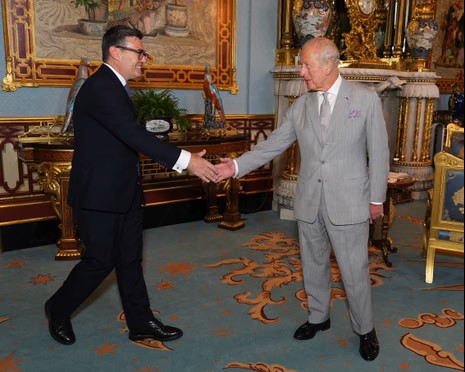
Andy Burnham, the former mayor of Greater Manchester and new leader of the Labour Party, took the final steps on Monday to succeed Keir Starmer and become Britain’s seventh prime minister in a decade.
The affable Burnham returned to Parliament in June by winning a risky special election and was sworn in as a member on July 12, hours after the unpopular Starmer announced his resignation to end a tenure of just two years in office.
Starmer traveled the mile from Downing Street to Buckingham Palace on Monday to formally tell King Charles III that he was resigning and Charles accepted, Buckingham Palace said.
The 56-year-old Burnham then arrived at the palace and accepted the invitation by Charles to form a government in a moment known as “kissing hands.”
Prime Minister Andy Burnham says politicians “need to be better” in his first speech as Britain’s leader.
He is promising to deliver a “circuit breaker” for a system he says has taken wrong turns since the 1980s.
Burnham spoke outside 10 Downing St. minutes after he was formally asked to form a government by King Charles III.
In a break with tradition, Burnham ditched using a lectern, speaking in front of two microphones outside the famous shiny black door of the prime minister’s residence.
Prime ministers typically speak from a lectern clad with the royal crest that features a lion and a unicorn, the national animals, respectively, of England and Scotland.
Burnham wasn’t even in Parliament a month ago
In order to challenge Starmer for the Labour Party’s leadership position, Burnham had to take a big political gamble.
He first had to win a seat in Parliament and then amass the necessary support to launch a bid to topple Starmer.
As internal pressure mounted in May for Starmer to resign, Josh Simons, the Labour lawmaker for the seat of Makerfield near Manchester, stepped down, triggering a special election.
The anti-immigration Reform U.K. party had recently devastated Labour in local elections in the area, which had led to calls for Starmer’s resignation.
The bet paid off for Burnham, who is well-known and popular in the area, and he breezed to victory when the votes were tallied June 19.
Dozens of Labour lawmakers cheered as he was sworn in June 22.
Starmer ultimately stepped down and Burnham faced no opposition in running to become party leader.
Burnham, known as a casual dresser, opts for formal attire
Dark T-shirts and dark jeans are typically part of the work uniform for Burnham, who is seen as a more relaxed and natural communicator compared to the buttoned-up Starmer.
But he changed out of his usual casual wear on Monday, donning a dark suit, white dress shirt and blue tie as he met King Charles III at Buckingham Palace to get the formal go-ahead to become prime minister.
Andy Burnham is Britain’s new prime minister
Andy Burnham has formally accepted an invitation from King Charles III to form a government.
Buckingham Palace has released a photo of the two men shaking hands. The ceremony known as “kissing hands” marks the transfer of power from former leader Keir Starmer to Burnham.
Burnham replaced Starmer as leader of the center-left governing Labour Party last week.
Why there is a change of prime minister without a general election
Burnham was chosen as Labour Party leader by 379 fellow lawmakers after Starmer said he was resigning. Because Labour holds a majority in government, its leader also becomes the U.K. prime minister.
Under Britain’s parliamentary democracy system, governing parties can change leaders midterm, with the winner becoming prime minister without the need for a general election. Prime ministers can be replaced if one has resigned as leader of their party, or been forced out by a leadership challenge.
It’s not unusual for British prime ministers to come to power without a broad election. In fact, four of the six British prime ministers in the past decade took the top job by winning internal party leadership contests to replace their predecessors, not by public vote.
The king’s role harkens back to a time when the monarch exercised supreme power and chose a prime minister to run the government.
Today, the king has no political power, but the monarch still officially offers the job to the leader of the party that can command a majority in the House of Commons.
The economy is the first item on the agenda
One of the biggest challenges facing Britain’s new prime minister is finding a way to kickstart the U.K.’s sluggish economy so that growing companies and increased output boost government revenue without raising taxes.
It’s a problem that has bedeviled every prime minister since the financial crisis of 2008. And their failure to solve it is part of the reason that Burnham is the U.K.’s eighth prime minister in the past 16 years.
The British economy has grown an average of less than 1.5 per cent annually since 2009, compared with an annual average of three per cent in the 15 years before the financial crisis.
While devising his economic plan, Burnham will be constrained by promises to reduce government debt, which now equals more than 95 per cent of gross domestic product, the highest since the early 1960s, while not raising taxes on working people.
In his final speech as prime minister, Starmer thanked the British people “for the opportunity to serve.”
“As I now pass the baton to Andy Burnham, I wish him every success,” he said. “He has my full support.”
“For all the focus on individuals, politics will always be a team sport, and the changes we’ve delivered for our country and our party belong to everyone who has fought for them,” Starmer said.
He ended by saying, “I go with good grace, I go with a smile, and I go proud of everything that we have achieved.”