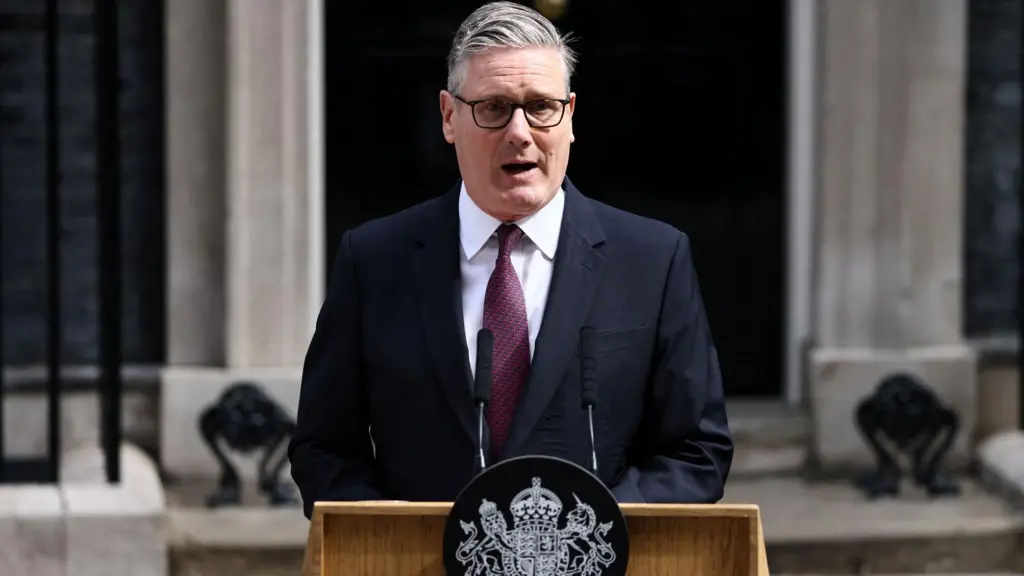
UK Prime Minister Keir Starmer has resigned after 23 months in power following mounting internal pressure and heavy losses for the Labour Party in local and by-elections. The decision triggers a Labour leadership contest, with prominent figures such as Andy Burnham and Wes Streeting expected to enter the race.
His resignation follows Andy Burnham’s dramatic victory in the Makerfield by-election, a result that was seen by many in Labour as proof that the former Greater Manchester mayor is able to beat Reform in a way Sir Keir could not.
Sir Keir took office in July 2024 following a landslide victory at the general election, but has since overseen a massive decline in popularity for the government as discontent with his leadership grew.
Mr Burnham, who defeated Reform UK’s Robert Kenyon by 9,231 votes, defied national trends to increase Labour’s share of the vote in an area where Nigel Farage’s Reform UK made sweeping gains in last month’s local elections.
Andy Burnham the man expected to take over the reigns at 10 dowining street
His victory was seen by some as proof that the former Greater Manchester mayor can beat Reform in a general election, with Mr Burnham’s allies calling on the prime minister to hand over power in the hours after the results.
The seat was vacated by Josh Simons earlier this year to allow him the chance of returning to Westminster to challenge Sir Keir, but Labour’s struggle to beat Nigel Farage’s party meant Mr Burnham was in for a tough fight.
The dramatic victory heaped even more pressure on the prime minister’s already strained position in No 10, after he was almost ousted following last month’s disastrous local elections.
John Healey resignation
Things were already looking terminal for Sir Keir when he was hit by the shock resignation of his defence secretary John Healey, who was quickly followed out of the door by armed forces minister Al Carns.
Mr Healey’s departure was a huge blow to the prime minister’s authority because he was seen as the ultimate party loyalist.
The two quit over a decision to only allocate £10b instead of £23bn to the Defence Investment Plan (Dip) at a time when the world is becoming increasingly dangerous with wars in Ukraine and the Middle East. Sir Ker had promised to get defence spending up to 3.5 per cent of GDP by the middle of the next parliament but offered no plan for that route.
More concerning was a Nato warning that the UK and its allies could be at war with Russia in five years.
Despite all this, the Treasury had won the battle with the Ministry of Defence to limit defence spending after months of indecision by Sir Keir.
Record local election losses
Under Sir Keir’s leadership, the Labour Party suffered back-to-back record defeats at the local ballot box, with last week’s result showcasing collapsed support in traditional Labour heartlands, as well as Scotland and Wales.
Sir Keir’s party lost 1,496 councillors across England, beating a record set by the Conservatives in 1981, and lost control of 38 councils. The party’s loss was largely Reform UK’s gain, as Nigel Farage’s party won 1,451 seats and 14 councils.
In Scotland, Labour’s hopes of increasing its vote share were dashed, a result the party’s leader in Scotland Anas Sarwar blamed on “national dissatisfaction” with the prime minister.
More concerning was a Nato warning that the UK and its allies could be at war with Russia in five years.
Despite all this, the Treasury had won the battle with the Ministry of Defence to limit defence spending after months of indecision by Sir Keir.
Record local election losses
Under Sir Keir’s leadership, the Labour Party suffered back-to-back record defeats at the local ballot box, with last week’s result showcasing collapsed support in traditional Labour heartlands, as well as Scotland and Wales.
Sir Keir’s party lost 1,496 councillors across England, beating a record set by the Conservatives in 1981, and lost control of 38 councils. The party’s loss was largely Reform UK’s gain, as Nigel Farage’s party won 1,451 seats and 14 councils.
In Scotland, Labour’s hopes of increasing its vote share were dashed, a result the party’s leader in Scotland Anas Sarwar blamed on “national dissatisfaction” with the prime minister.
The situation was even worse for the party in Wales, with Labour losing control of the Senedd for the first time since it was created in 1999 as its vote share fell by more than half to third place.
Responding to the dire results, Sir Keir said he was “taking responsibility” but announced his intention to stay on, telling the country, “just as I take responsibility for the results, I also take responsibility for delivering the change that we promised for a stronger and fairer Britain that we must build.”
However, the pressure from within his own party would prove too much for the outgoing prime minister, who announced his resignation after crunch talks with his cabinet on Tuesday.
Keir Starmer made several claims about his record as prime minister when he announced his resignation.
But last year’s total was the second highest after 2022’s peak under the previous Conservative government.
Starmer’s government has cut the use of hotels for asylum seekers – transferring them to other types of accommodation including former military sites. Government figures do not show the number of asylum seekers in houses of multiple occupancy.
‘The biggest uplift in defence spending since the Cold War’
Starmer’s government planned to spend 2.5% of GDP in 2027/28, rising to 3% in the next parliament, making it the biggest increase since the Cold War.
In the 1950s, defence spending was over 7% of GDP. By 1989 – when the Berlin Wall came down – it was 3.3% and at times has fallen below 2%, so spending 2.5% of GDP on defence would eclipse any small increases since the 1990s.