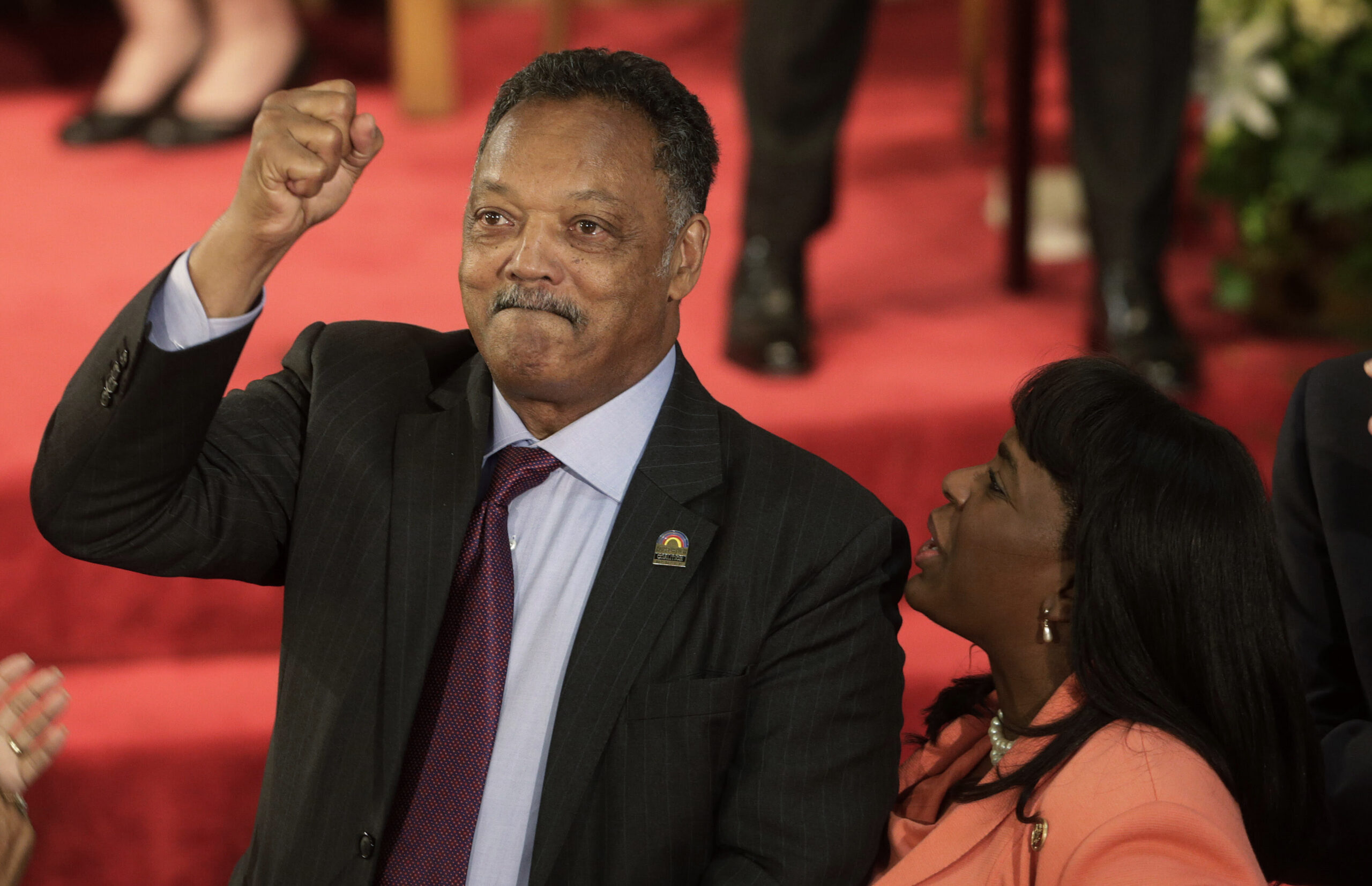
Jackson’s presidential runs in 1984 and 1988 played a significant role in shaping the modern Democratic Party
The Rev. Jesse Jackson, a civil rights leader who bridged the era of Martin Luther King Jr. with the modern world and whose two presidential runs in the 1980s set the stage for today’s progressive movement, died early Tuesday, his family announced. He was 84.
“Our father was a servant leader ― not only to our family, but to the oppressed, the voiceless, and the overlooked around the world,” the family said in a statement. “We shared him with the world, and in return, the world became part of our extended family. His unwavering belief in justice, equality, and love uplifted millions, and we ask you to honor his memory by continuing the fight for the values he lived by.”
The statement did not list a cause of death but noted that Jackson died peacefully surrounded by family.
Jackson was diagnosed with Parkinson’s in 2013. His diagnosis changed to progressive supranuclear palsy, a neurodegenerative disorder, in April 2025, his Rainbow Coalition/PUSH organization said.
He was hospitalized in November for about two weeks and later also received care at an acute nursing facility for the condition.
The Rev. Al Sharpton paid tribute to Jackson in a statement , writing that “our nation lost one of its greatest moral voices.”
“Reverend Jackson stood wherever dignity was under attack, from apartheid abroad to injustice at home. His voice echoed in boardrooms and in jail cells. His presence shifted rooms. His faith never wavered,” Sharpton wrote.
Born in segregated Greenville, South Carolina, Jackson was a prodigy who would become nationally known by his early 20s, become a controversial figure in both white and Black America by the age of 30, help resolve international crises in his 40s, host a CNN show and become a presidential confidant in his 50s, and become a respected elder statesman in the new millennium.
An electrifying speaker, Jackson could never escape the criticism that he was more flash than follow-through. Other politicians, even ideological allies, viewed him as untrustworthy and ego-driven. Conservatives argued Jackson added fuel to the fire of racial divides for his own benefit.
Electoral success eluded him — his only successful campaign was for a wholly symbolic office in Washington, D.C. But his campaigns for president in 1984 and 1988 helped create the image of what the modern Democratic Party seeks to be but rarely seems to achieve: a multiracial coalition of voters dedicated to economic fairness.
“If there was no Jesse Jackson, in my view, there never would have been a President Barack Obama,” Sen. Bernie Sanders (I-Vt.) said in 2020 while campaigning alongside Jackson, a man he has repeatedly cited as an inspiration. However, Jackson, who campaigned as an unflinching economic progressive and critic of American foreign policy, also set the stage for Sanders’ own runs for the presidency.
Jackson was the son of an unwed teenage mother who grew up across the street from his father’s legitimate family, a rejection that friends told reporters still stung decades later. He became class president and a star athlete in high school, and later played college football at the University of Illinois and North Carolina A&T. He graduated from the latter school in 1964 with a degree in sociology, also serving as class president there.
After participating in a sit-in at a public library in Greenville while in college, he moved to Chicago to attend divinity school and become more involved in the Civil Rights Movement. He participated in marches from Selma to Montgomery in Alabama and established a branch of the King-led Southern Christian Leadership Conference in Chicago. He was later appointed to lead SCLC’s economic arm, Operation Breadbasket, which organized boycotts of businesses the organization believed did not promote economic opportunities for African Americans.
Jackson’s evident ambition and drive impressed and occasionally annoyed King, but they chafed other civil rights leaders. His actions following King’s assassination in 1968 would lead to a permanent split between him and King’s family. Jackson, who was standing below the balcony where King was shot, appeared on television the next day wearing a shirt stained with King’s blood. Other SCLC leaders were appalled, and Coretta Scott King never forgave Jackson.
In 1971, Ralph Abernathy and others pushed Jackson out of SCLC leadership, even though he argued he was merely continuing King’s desire to focus on economic justice.
Jackson, in a 2008 interview with CNN, defended his actions in the wake of King’s death as those of a traumatized young man: “If I made mistakes in those hours, they were the mistakes of grief, not ambition.”
Jackson went on to found PUSH, or People United To Serve Humanity, which led or threatened high-profile boycotts of businesses including McDonald’s, Anheuser-Busch, Sears and Japanese automakers. He asked the companies to hire more Black employees, invest more in Black communities and businesses, and advertise more in Black-owned media.
“The new frontier of civil rights is economic — silver rights,” Jackson said in a speech in 1984. “If we can spend a trillion dollars a year as consumers, we ought to have something to show for it besides receipts.”
Conservatives and business leaders would denounce Jackson as little more than a shakedown artist, arguing the commitments he secured from companies seeking to avoid or end boycotts did more to benefit his political allies than the Black population at large.
He also became a somewhat unlikely negotiator for the United States while dealing with left-wing authoritarian governments around the world: He negotiated with Syrian President Hafez al-Assad in 1983 to secure the release of an American pilot shot down over Lebanon, and with Cuban dictator Fidel Castro the next year for the release of 22 Americans held there.
These bouts of international statesmanship helped set the stage for Jackson’s presidential runs in 1984 and 1988. Made during President Ronald Reagan’s administration — the peak power of the conservative movement — Jackson’s run, especially his second, would form the basis of the modern progressive movement, the earliest stirrings of progressive dissent from neoliberalism. He challenged the so-called “Atari Democrats,” young, moderate politicians like Colorado Sen. Gary Hart, then-Arkansas Gov. Bill Clinton and Massachusetts Gov. Michael Dukakis.
Jackson tried to escape the idea that he was a candidate specifically for Black voters, beginning to transform himself into an economic populist. He won over the Alabama state legislature, whose membership included former National Guardsmen who stared him down as a protester, with a speech railing against “Honda and Toyota, Suzuki and Yamaha, Sony and Panasonic, being unloaded at the docks and replacing Buick and Chrysler in the American market.”
He turned the tiny town of Greenfield, Iowa — population roughly 2,200 in 1980 and lily-white — into a statewide campaign headquarters, winning over farmers with his knowledge of agricultural economics.
He wanted to double the federal education budget, endorsed a version of what we now call “Medicare for All,” and proposed the creation of a national infrastructure bank, tax hikes on the rich and a freeze on military spending. He denounced the Reagan administration’s wars in Central America and its close relationship with apartheid South Africa. He campaigned on Native American reservations and reached out to gay and lesbian voters.
“Our flag is red, white and blue, but our nation is a rainbow ― red, yellow, brown, black and white ― and we’re all precious in God’s sight,” he said in a speech at the 1984 Democratic National Convention, adding: “We must leave racial battle grounds and come to economic common ground and moral higher ground. America, our time has come.”
In the first campaign, he was treated mainly as a nuisance. His dream of an alliance between Blacks and progressive whites seemed foolhardy. But after winning 18% of the vote, including more than four-fifths of the Black vote, he began his second campaign in 1988 as a threat.
His outreach to working-class whites picked up. White economic populists like Texas’ Jim Hightower backed him, and he won over three times as many white votes as he did in 1984 — “A lot of them are real rednecks,” he joked about his new supporters. He earned nearly 30% of the vote and won 13 primaries or caucuses, essentially sweeping the Deep South. He took the race to the convention and fell short to Dukakis.
Writing in Time magazine after the election, the historian Garry Willis said Dukakis’ loss was due in large part to his decision to keep Jackson and the liberal populism he represented at arm’s length: “Dukakis treated Jackson as an embarrassment, something he had to cope with, placate, keep a healthy distance from. This would lead him into his worst mistake, the renunciation of ideology, the attempt to build a middle constituency from scratch in the name of ‘competence.’ In effect, he fled his base instead of building on it.”
For all his progressive bona fides, Jackson was a minister with a distinct social conservative streak. He opposed abortion rights early in his political career, calling abortion “the ultimate human rights issue.” He bemoaned teen pregnancy and “babies making babies.” He lectured teenagers about the evils of drug use, supported the death penalty for drug traffickers and was in favor of putting more cops on the street.
“If we do not set moral standards for our children, the drug merchant will,” he told a gathering of Black ministers in 1988.
Jackson’s campaigns registered Black voters en masse, which party operatives credited with helping Democrats to win control of the Senate in 1986. They also served as an incubator for a cadre of Black women who would go on to play major roles in Democratic politics, including Donna Brazile, the Rev. Leah Daughtry and Minyon Moore.
Throughout the 1980s in particular, Jackson battled accusations of antisemitism after he referred to New York City as “hymietown” when speaking to a Washington Post reporter, which he would later apologize for. He also refused to distance himself from Louis Farrakhan, a fellow Chicago-based Black political and religious leader with a long history of antisemitic remarks.
In the 1990s, Jackson’s fame led him to host a debate show on CNN, titled “Both Sides With Jesse Jackson.” Most episodes featured two experts or politicians debating a topic, with Jackson primarily serving as moderator and often delivering an editorial comment at the end of an episode.
He also won his only election in 1990, moving to Washington, D.C., to become one of the district’s two “shadow senators” — an unpaid job dedicated to lobbying for D.C. statehood. Local reporters noted Jackson was not always present in D.C., even missing the first day of Congress’ session in 1991 to address a conference of television executives in Los Angeles. He did not run for reelection in 1996.
In June 1992, Jackson would unwittingly become the host of one of the most famous political maneuvers in history. Clinton, then the front-runner for the Democratic nomination, appeared at a conference for the Rainbow Coalition and denounced the group for giving a platform to Sister Souljah, a singer and rapper with a history of controversial remarks.
The speech seemed designed to embarrass the more liberal Jackson. Years later, he would tell The Washington Post he made a strategic decision to move on from the incident.
“I suppose the lowest moment in the relationship was the Sister Souljah tactic that was employed against us at our conference,” Jackson said during an interview about his relationship with Clinton. “It was in many ways beneath his dignity … I had to accept the personal blow for the higher and greater good.”
After spending much of the 1980s working to defeat the Atari Democrats and the moderate Democratic Leadership Council, Jackson spent the 1990s advising Clinton, the DLC’s greatest success. While criticizing Clinton’s moves to reform welfare, he advised him on other issues and became a spiritual supporter in the aftermath of Clinton’s affair with Monica Lewinsky and subsequent impeachment. In 2000, Clinton awarded Jackson the Presidential Medal of Freedom.
In theory, Jackson should have had a smoother relationship with the next Democratic president, Barack Obama. The two shared a hometown in Chicago and ran in the same circles of politically influential Black leaders. Jackson’s eldest daughter was even the maid of honor at Barack and Michelle Obama’s wedding.
Jackson endorsed Obama’s presidential run in 2008, though his wife supported then-New York Sen. Hillary Clinton. But Jackson’s friends told reporters that the elder man clearly believed Obama did not pay him sufficient deference or credit the ways his campaigns for president had paved the way for Obama’s successful run.
These tensions spilled out into the open in July 2008, when a hot mic on Fox News caught Jackson saying he wanted to “cut [Obama’s] nuts off … for talking down to Black people” after Obama delivered a speech chastising absent Black fathers. Jackson quickly apologized for his comments, but he never joined Obama’s inner circle the way he did with Clinton.
Jackson married Jacqueline Brown in 1962, while the pair were still students at North Carolina A&T. Brown valued her privacy and was a low-profile political spouse, once warning reporters not to expose any affair her husband had.
“If my husband has committed adultery, you better not tell me, and you better not go digging into it,” she told reporters in 1987. “I’m trying to raise a family and won’t let you destroy it.”
Jackson fathered a child in an extramarital affair with a Rainbow Coalition/PUSH employee in 1999, with the affair becoming public in 2001. The press duly covered the revelations, which led CNN to cancel “Both Sides.”
Jackson and Jacqueline had five children: Sanita, Jesse Jr., Jonathan, Yusef and Jacqueline. Jesse Jr. served 17 years in Congress representing Illinois before resigning amid a federal corruption investigation. He eventually pleaded guilty to mail fraud and served 30 months in prison. Jonathan Jackson won a seat in Congress, also representing Illinois, in 2022.
By the time society renewed its focus on social and racial justice in the mid-2010s, Jackson had already ascended to statesman status, and a Parkinson’s diagnosis — later revealed to be the aforementioned palsy — became public in 2017.
Jackson did not stop his activism, however. He led a protest march in Ferguson, Missouri, following the police shooting of Michael Brown. He traveled to Minneapolis after the death of George Floyd to press the district attorney there to charge the officers involved.
He finally stepped down from the leadership of Rainbow/PUSH in 2023, though he continued to speak out on significant issues. He condemned Israel’s response to the Oct. 7 attacks that year, calling the war in Gaza a “massacre” and encouraging student protesters across the United States. And before the 2024 election, he warned that President Donald Trump “wants to pull us back into white supremacy.”