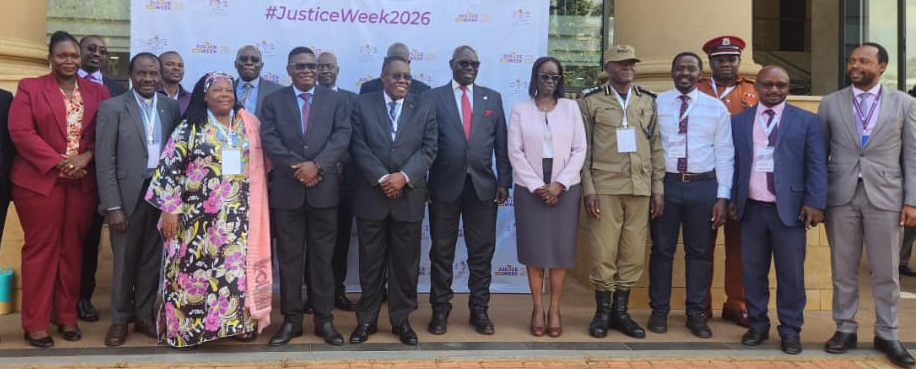
Justice and Constitutional Affairs Minister Norbert Mao , has announced the deployment of mobile courts to expeditioussly handle cases of public servants who have been arrested for alleged corruption and abuse of office in the on -going operations led by his Local Governments counterpart Balaam Barugahara.
Mao explained that the mobile courts arrangement would ensure that people arrested during the operations are brought before the judicial process quickly to avoid miscarriage of justice and do not appear arbitrary.
The Office of the Director of Public Prosecutions (ODPP) will sanction charges, magistrates will hear cases, while prison officers will handle suspects ordered to be remanded, Mao stated .
The Minister was officiating at the opening of the Annual Justice Week and National Justice Forum at the Justice, Law and Order Sector (JLOS) Tower in Naguru Kampala.
The two week programme will feature free legal aid, public dialogues, a justice innovation hackathon competition where the winners will get a cash prize and an open review of sector performance.
The event, organised by the Justice Law and Order Servises (JLOS), Under the Ministry of Justice and Constitutional Affairs, will run from Monday, 23 November to Friday, 4 December 2026, under the theme “Advancing Integrated People Centered Justice, Law and Order Delivery System for Social Economic Transformation.”
It also marks 25 years of the Justice, Law and Order Sector (JLOS), the sector-wide approach that coordinates institutions across the justice chain.
Mao said the government will rely on the recently passed regulations governing mobile courts to process case files of corruption suspects arrested in the on-going anti-corruption operations.
“Now that we have regulations for mobile courts, we are going to ensure that wherever he is, because we are losing trillions through these local government corruption networks. But we don’t want it to appear as if it is a kind of arbitrary process where you are just arrested and taken and so on. We are going to ensure that we comply with our justice system procedures,” Mao said.
The minister told the JLOS stakeholders and members of the public attedning the Justice Week 2026 that prosecutors will be at hand to review and sanction case files, while magistrates will preside over cases and determine whether suspects should be remanded and have matters fixed for hearing .
“The DPP will be there to sanction your file in a tent immediately. Now that we have the Chief Justice’s instrument on mobile courts, there will also be a magistrate waiting to hear your case and remand you immediately. And prison officers will be waiting to take you where you should be kept,” he said.
Mao acknowledged concerns from some politicians and members of the public that the anti-corruption operations conducted by Balaam appeared arbitrary because suspects were arrested and taken away without due process being clearly demonstrated.
“So far, right now, it is appearing like it is too arbitrary. I’ve seen some politicians complaining. So we are going to do it now properly,” he said.
He said the proposed system would involve separate operational stations where police would receive complaints and record statements, prosecutors would examine and sanction files, and magistrates would handle cases before prison officers take custody of suspects ordered to remand.
“That is the support we want to give to Balaam, the Minister of Local Government,” Mao said.
He added that he had invited Balaam to the justice sector engagement to personally explain the support he requires from the different institutions.
Mao also roots for community based dispute resolution mechanisms
Mao called for community-based dispute resolution mechanisms to compliment the formal court systems in determining and disposing off misdemeanor (minor) cases quickly – in a concerted effort to embrace alternative justice tools and processes that will reduce the endemic challenge of backlog cases .
He said local council courts, traditional leaders, elders and other community structures should be empowered to resolve disputes in reduced timelines and with little cost .”Ddialogue, mediation and reconciliation, should part of our justices processes at all times ,” he emphasised .
“Justice must be local. We have the Local Council Courts Act 2006. The LC1 courts are the best courts. Everybody who knows about a matter comes and gives reliable witness. And it’s very difficult to suppress the truth. And they speak in a language everybody understands,” Mao added.
Mao cited five legal frameworks that should guide the expansion of community justice. These include the Local Council Courts Act, 2006; the National Transitional Justice Policy, 2019; the National Alternative Dispute Resolution Policy, 2025; guidelines on informal justice systems; and the Judiciary’s Alternative Justice Systems currently being piloted in Acholi and Lango.
He said the objective was to establish a people-centred justice system in which formal courts work alongside community-based mechanisms rather than compete with them.
“When we talk about informal practice, it must align with the Constitution, human rights, equality and non-discrimination. We are committing that this is not a competing justice system, but a complementary one,” Mao said.
Rachel Odoi-Musoke, Senior Technical Adviser for the Governance and Security Programme, noted that formal justice system alone could not address all the justice needs of Ugandans.
She told the audience that many communities continue to rely on local council courts, cultural and religious institutions, traditional leaders, elders and other recognised structures to resolve disputes, address grievances and maintain social harmony.
Racheal Odoi-Musoke ,Senior Technical Adviser for the Governance and Security Programme and , Canon Sam Rogers Wairagala , (in the back ground ) theDeputy Senior Technical Advisor and Technical Advisor for Monitoring and Evaluation at the Governance and Security Programme
“These mechanisms are often the first point of contact for individuals and families seeking justice. Their accessibility, familiarity and emphasis on dialogue, reconciliation and restoration make them important partners in the administration of justice,” Odoi-Musoke said.
She said justice sector institutions had over the years introduced several reforms aimed at making justice more accessible, affordable, timely and responsive to people’s needs.
Among the postive reforms that have registered people -centered outcomes include mobile courts, mobile legal aid clinics, community service, victim participation in sentencing and alternative dispute resolution initiatives.
Odoi-Musoke said the justice interventions introduced over the years need to be supported by stronger partnerships between formal justice institutions and community-based structures. ” There is need for collective effort to strengthen the relationship between formal and informal justice mechanisms,” she stressed .
The Senior JLOS Technocal Adviser highlighted someof the policy frameworks Uganda has made in a deliberate effort to quicken justice for the people including but not limited to the etablishment of the legal and policy framework for community justice through the Local Council Courts Act of 2006, the National Transitional Justice Policy of 2019 and the National Alternative Dispute Resolution Policy of 2025.
On an encouragemntment note she added that the sector, working with the Uganda Law Reform Commission, was developing guidelines to provide direction on the use of informal justice mechanisms in the administration of justice.
Odoi-Musoke howveer hastened to add that translation of policy commitments into practical arrangements were still some of the major challenges facing the sector.
“The challenge before us is how to translate these policy commitments into practical arrangements that facilitate effective coordination, referrals, accountability and collaboration between formal and informal justice actors,” Odoi-Musoke said.
She emphasised that community-based justice mechanisms must operate within the country’s constitutional and human rights framework, particularly in protecting women, children and other vulnerable members of society.
“We must also ensure that community justice mechanisms operate in accordance with the Constitution, human rights principles and the rule of law, with particular attention to protecting women, children and other vulnerable members of our community,” she said.
Odoi-Musoke said the National Justice Forum was convened to build consensus on how formal and community-based justice institutions could work together, clarify the responsibilities of different actors and share experiences from Uganda and the wider region.
She urged participants to ensure that the discussions resulted in practical commitments rather than resolutions that were never implemented.
“The success of this dialogue will ultimately be measured not by the discussions we hold today, but by the practical actions and commitments that follow,” she said.
She also questioned the terminology commonly used to describe community-based justice, arguing that the phrase “informal justice” could create the impression that these mechanisms operate outside the recognised justice system and established legal norms which is not the case.
“One of the issues that we have constantly grappled with was using the term informal justice. And I think oftentimes we’ve been advised to use either alternative justice or African justice mechanisms,” she said.
She added that stakeholders needed to agree on terminology that appropriately reflects the role of community-based mechanisms within Uganda’s broader justice framework and context.
Odoi-Musoke reaffirmed the sector’s commitment to providing technical and coordination support to strengthen community justice initiatives.
Margaret Ajok , the Transitional Justice Advisor at Uganda’s Justice, Law and Order Sector secretariat
The Community Justice dialogue held under the theme: “Leveraging community justice mechanisms for a people,” was prepared and supritended over by Margaret Ajok , the Transitional Justice Advisor at Uganda’s Justice, Law and Order Sector and was also attended by Justice (Rtd.) James Munange Ogoola, who made remarks about the Nexus between community justice and the formal judicial system.
Justice Ogoola has frequently critiqued the heavy case backlogs, high costs, and rigid technicalities that plague formal adjudication in Uganda, particularly regarding land disputes. He advocates for community mediation and Alternative Dispute Resolution (ADR) as essential, culturally legitimate complements to formal courts.
Through his leadership in the Elders’ Forum of Uganda, Ogoola has highlighted the historical and ongoing responsibility of community elders to mediate conflicts locally before they escalate into protracted formal litigation or national crises.