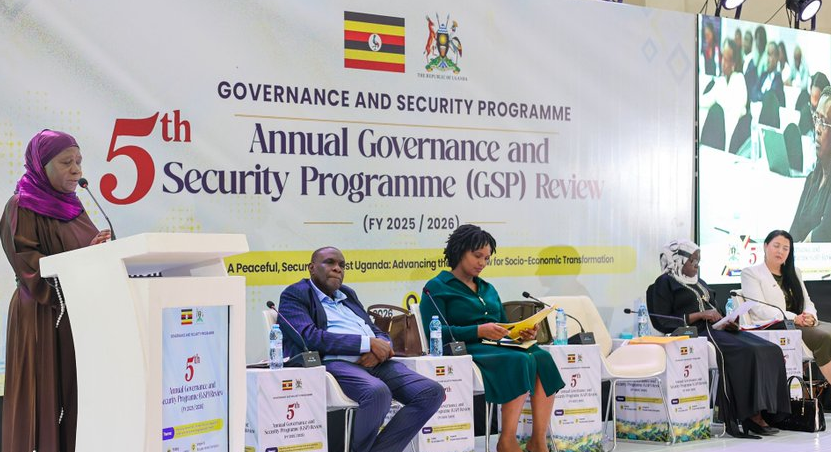
The Minister for the Presidency, Milly Babalanda, has called for improved institutional performance , effective implementation of government programmes and stronger accountability in the 32 government’s Governance and Security Programme (GSP) agencies .
Babalanda stressed that the achievements so far recorded under the period under review should be felt and appreciated by the ordinary Ugandans at the grassroots.
Babalanda also called upon government institutions to deal with the persistent performance gaps in accountability, gender equity, refugee resilience and international cooperation if Uganda is to achieve its national development ambitions.
In a speech delivered on her behalf by the Minister for Kampala, Hajait Minsa Kabanda, during the opening of the 5th Annual Performance Review of the Governance and Security Programme (GSP) for the 2025/2026 financial year at Imperial Royale Hotel in Kampala, Babalanda noted the progress made but hastened to add that the – ultimate measure of success should be the impact of government interventions on citizens.
“We must be careful not to equate the performance with the achievement of our national objectives,” she said, urging implementing institutions to focus on outcomes that improve governance, security and public service delivery.
The well attended review held under the theme under the theme: ‘a peaceful and secure Uganda; advancing the rule of law and enabling social economic transformation’ brought together government institutions, development partners, civil society organisations and other stakeholders to assess progress in governance, security, justice, human rights and accountability.
Among the areas requiring urgent attention, Babalanda highlighted Uganda’s performance on governance indicators, noting that the African governance index stood at 49.21 per cent against a target of 60 per cent.
Implementation of audit recommendations stood at 59 per cent, while gender and equity compliance reached 61 per cent against a target of 70 per cent.
The country’s refugee resilience performance also remained below expectations at 39 per cent against a target of 53 per cent, with declining financing identified as a major constraint.
The international cooperation score similarly remained below its target, while another performance indicator, which recorded a score of 0.104, fell short of the planned target of 0.385.
Babalanda said the gaps reflected the need for stronger implementation, improved institutional coordination and more effective utilisation of public resources.
The Minister challenged government institutions to ensure that audit recommendations are acted upon rather than left outstanding, while gender and equity commitments must be reflected in government budgets, expenditure and service delivery.
“These results require our collective attention,” she said, calling on participants to identify the underlying causes of poor performance and propose realistic, measurable and time-bound interventions.
The minister also emphasised patriotism as a critical requirement for effective implementation of the Governance and Security Programme, saying public officials must place national interests above personal ambitions.
“Patriotism is not merely an expression of love for our country. It is demonstrated through our commitment to protecting the vital interests, preserving national unity, respecting the law and serving our people with integrity,” Babalanda said.
She said government officials should demonstrate patriotism by safeguarding public resources and ensuring that government interventions deliver value to citizens.
Development partners, she added, should align their financial and technical support with national priorities, strengthen institutional capacity and promote sustainable development rather than create dependence on external funding.
Babalanda further urged civil society organisations and other non-state actors to contribute to national development through constructive engagement, independent oversight, service delivery and evidence-based advocacy.
The minister outlined the five strategic priorities that should guide implementation of the GSP to include consolidating peace and security, strengthening governance and accountability, improving access to justice and protecting human rights, advancing inclusive governance and resilience, and strengthening programme coordination and results-based management.
On security, she called for sustained progress in crime reduction, expanded policing coverage and improved institutional readiness to respond to emerging security threats.
On governance and accountability, she emphasised the need for more effective policy and legislative processes, stronger anti-corruption measures, improved compliance with audit recommendations and greater value for public expenditure.
She also called for investment in justice infrastructure, forensic capacity and institutional reforms to improve access to timely and responsive justice services.
On inclusive governance, Babalanda said government must address gender and equity gaps while strengthening support systems for refugees, particularly amid financing constraints affecting refugee protection and resilience programmes.
She warned that the effectiveness of these interventions would depend on clearly defined institutional responsibilities, measurable performance indicators, realistic timelines and regular follow-up.
The minister also called for stronger coordination between government institutions and development partners, cautioning against duplication of interventions and urging stakeholders to assess partnerships based on actual results rather than resources mobilised or activities undertaken.
“Partnerships should be assessed not only by the resources mobilised or activities undertaken, but by the results achieved and the institutional capacities strengthened,” she said.
Babalanda said government retained the primary responsibility for providing leadership, policy direction, institutional coordination and accountability for national development results, but acknowledged that achieving these objectives required cooperation with other stakeholders.
The Fifth Annual Performance Review comes during the first year of implementation of the Fourth National Development Plan (NDP IV), covering the 2025/2026 to 2029/2030 financial years, which seeks to strengthen governance, security and the rule of law as foundations for national development.
Babalanda urged participants to ensure that resolutions reached during the review translate into concrete action in the coming financial year.
“The value of this annual review will ultimately depend on how effectively its recommendations inform the work of government and its partners during the coming financial year,” she said.
The Permanent Secretary in the Office of the President who is also the Chairperson GSP programme working group, Hajj Yunus Kakande told the meeting that the strategic contribution of the 32 GSP government agencies is to enable the national transformation agenda by putting in place the necessary governance conditions that facilitate inclusive social and economic development..
“We re-enforce the economic driving sectors in the pursuit of the Uganda Vision 2040, the African Union Agenda 2063, and the United Nations Agenda 2030,” he added .
Hajj Kakande thanked Uganda’s development partners for their continued interventions in the country’s development journey . “While the duty and responsibility of ensuring adherence to the rule of law, human rights, democracy, accountability and promotion of peace and security in Uganda lies with the government of Uganda, I acknowledge the contributions of our development partners that are an indelible substantial proportion of our fabric,” Hajji Kakande stated .