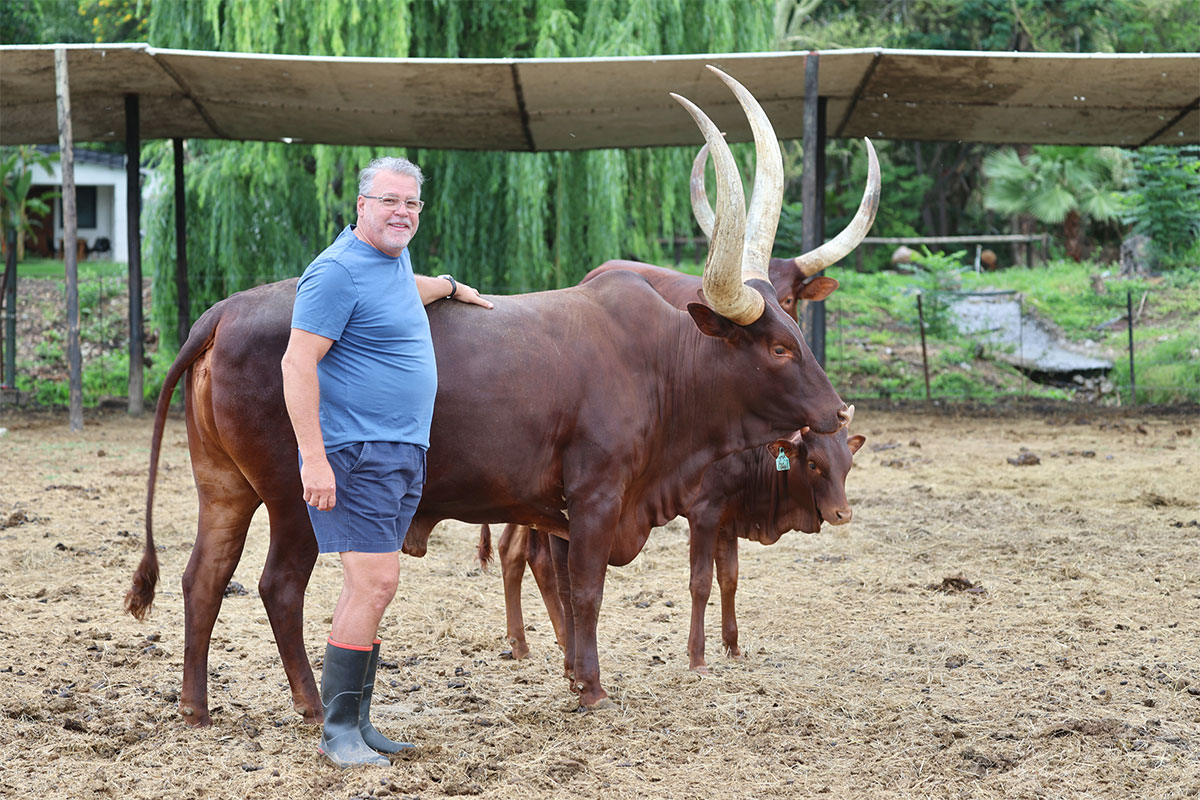
For Edwin Hewitt and his family at Hope Private Game Reserve in Limpopo, Ankole cattle are more than a striking African breed with enormous horns. They represent a long-term investment in genetics, resilience, and African livestock heritage, with the potential to contribute meaningfully to future commercial beef systems.
Image: Supplied
The Hewitt family has spent years building a reputation in wildlife breeding. Buffalo, sable, roan and nyala formed the backbone of the reserve’s breeding programme for years, but since 2023, the focus has increasingly shifted towards one of Africa’s most visually distinctive cattle breeds, the Ankole.
The move into Ankole breeding was not accidental. According to Hewitt, the breed’s combination of beauty, adaptability and deep African roots immediately stood out.
“What first attracted me to the Ankole was the combination of majestic beauty, history, hardiness, and African identity. It is a breed that carries presence and heritage, but also real value,” says Hewitt.
For many South Africans, Ankole cattle remain associated with their spectacular horns, which can stretch well over a metre from tip to tip. Yet serious breeders insist the breed’s future relevance lies far deeper than appearance alone.
Hewitt believes the cattle’s ability to thrive under extensive conditions, combined with traits such as fertility, longevity and disease tolerance, positions them well for Southern African production systems facing increasing pressure from climate variability and rising production costs.
“The most valuable traits are fertility, adaptability, longevity, temperament, mothering ability, disease tolerance, and efficient conversion on natural veld. These are the traits that make the breed commercially relevant,” he says.
Building a herd through elite genetics
Unlike many conventional cattle enterprises that build numbers gradually through natural expansion, Hope Private Game Reserve adopted an embryo-based breeding strategy from the outset. The aim was to accelerate genetic progress while maintaining strict selection standards.
“Our vision was simple, to build an exceptional herd from the best available genetics,” says Hewitt. “Our approach has always been selective.”
The programme has been supported by reproductive specialists Drs Morne and Sean-Luc de la Rey, as well as the team at EmbryoPlus, a well-known South African reproduction and embryo-transfer business. Embryo technology has become increasingly important in the South African stud industry over the past decade, particularly among high-value game and cattle breeders seeking to multiply elite bloodlines rapidly.
For the Hewitts, the strategy allows them to establish consistency within the herd while introducing sought-after bloodlines linked to prominent Ankole animals such as Optimus Prime and Maximus, alongside elite females including Daisy and Adira.
Despite the emphasis on elite genetics, Hewitt says visual appeal alone is not enough.
“We focus on structure, fertility, temperament, frame, functional udders, strong feet and legs, adaptability, horn symmetry, and overall balance. Beauty matters in Ankole, but function must always come first,” he explains.
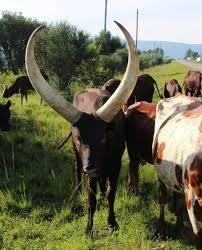
Image by Uganda Tourism Board
That balance between aesthetics and functionality is becoming increasingly important as breeders seek to position Ankole cattle not merely as niche collector animals, but as commercially relevant livestock capable of contributing to mainstream beef systems.
Adapted to tough African conditions
One of the major attractions of the Ankole breed is its adaptability to extensive African environments. Originally associated with East Africa, particularly Uganda, Rwanda, and neighbouring regions, Ankole cattle evolved under challenging grazing and climatic conditions. This history has contributed to their reputation for hardiness and resilience.
“Our Ankole perform very well under Limpopo conditions,” says Hewitt. “They are hardy, adaptable and efficient animals.” He adds that their ability to function under tougher veld conditions is one of the reasons he believes the breed has a significant future in Southern Africa. This adaptability may become increasingly valuable as farmers face mounting environmental and economic pressures.
South African livestock producers are currently operating in an environment shaped by climate uncertainty, higher feed costs, biosecurity concerns, and recurring disease outbreaks such as foot-and-mouth disease. According to Hewitt, these realities have forced breeders to become more disciplined.
“Movement restrictions, biosecurity, feed costs, and market uncertainty all have an impact. It has taught us to focus even more on quality, resilience, and long-term sustainability rather than short-term volume,” says Hewitt.
“Ankole cattle are well suited to extensive systems. They are strong walkers, adaptable grazers and capable of performing in challenging veld conditions,” he explains.
Preserving African livestock heritage
Beyond economics and production efficiency, breeders also see the Ankole as part of Africa’s agricultural heritage. In recent years, there has been growing interest among breeders and conservation-minded farmers in preserving indigenous and historically significant livestock genetics.
While exotic breeds often dominate commercial beef systems, indigenous or African-adapted genetics are increasingly valued for their resilience and environmental suitability.
“The Ankole has an important role to play in preserving African livestock heritage,” he says. “It is not only a beautiful breed; it is a symbol of resilience, adaptability and African identity.”
This cultural and historical significance partly explains the emotional connection breeders develop with the animals. For the Hewitt family, the project also carries a generational dimension.
“What keeps us enthusiastic is the opportunity to help build something exceptional for our grandchildren,” he says.
That long-term perspective shapes much of the breeding philosophy at Hope Private Game Reserve. Rather than chasing rapid expansion or short-term commercial gains, the emphasis remains on stewardship and sustainable genetic progress.
“Breeding Ankole has taught us patience, respect for genetics, and the importance of building for the long term,” Hewitt explains. “Farming is never only about animals; it is about stewardship, resilience, conservation and leaving something meaningful behind.”
Potential role in commercial systems
Although Ankole cattle remain associated with stud breeding and niche markets, interest is gradually expanding beyond purebred enthusiasts. Breeders increasingly believe the genetics could add value in crossbreeding systems, particularly in harsher production environments where hardiness and adaptability become critical.
According to Hewitt, commercial producers may benefit from traits such as heat tolerance, fertility, and resilience. “In crossbreeding programmes, Ankole genetics can bring resilience and efficiency, especially in tougher environments,” he says.
This mirrors broader global trends in cattle breeding, where producers are increasingly seeking genetics that balance productivity with adaptability, especially under changing climatic conditions. For Hope Private Game Reserve, however, the immediate focus remains on developing a fertile, functional, and visually exceptional herd.
“Our future benchmark is a fertile, low-maintenance herd that can reproduce consistently under extensive conditions,” says Hewitt.
Its spectacular horns may attract initial attention, but breeders such as Hewitt argue the breed’s true value lies in what happens beyond appearances: adaptability, resilience, and the ability to perform under the demanding conditions that increasingly define Southern African farming.
Editor’s Note: This article was first published by Farmer’s weekly