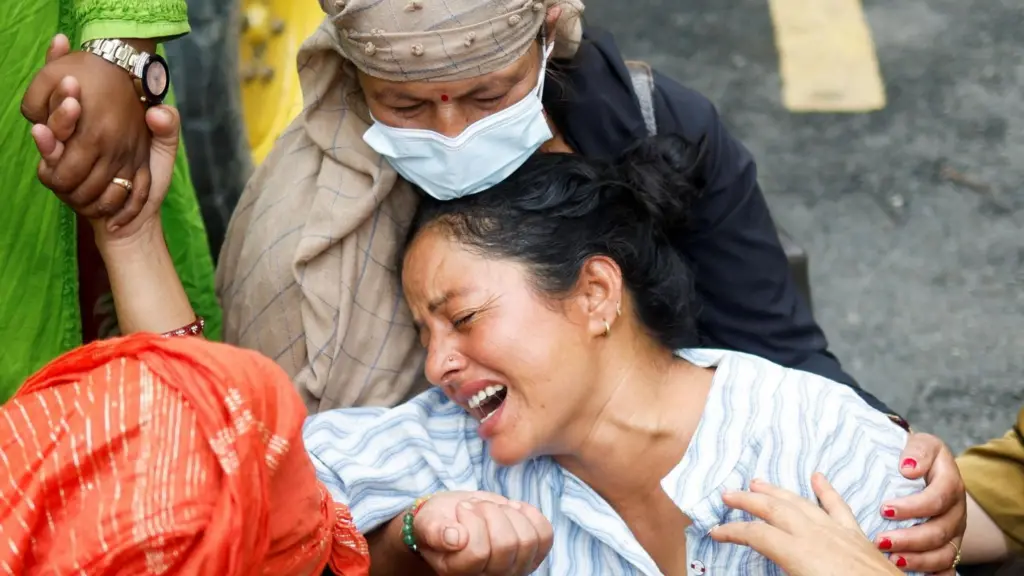
The search for survivors in Tibet and Nepal continues after hundreds of people were killed in flash floods.I
The death toll has now reached 939 and another 4,793 people are unaccounted for and of the missing persons , 853 are foreign nationals.
The glacial collapse that is said to have caused the flash floods happened on the Nepal side of the Himalayan mountains, Nepalese officials told the media .
Countries and organisations around the world have been sending aid to Nepal, including Britain, with Prime Minister Andy Burham pledging £5 million in aid earlier today.
Rescuers have continued to search Himalayan valleys and hillsides after a flash flood that killed at least 359 people and left nearly 1,000 missing, as Nepal and China warned of a risk of fresh flooding from water pooling in two lakes.
Both countries said a glacier collapse on Wednesday morning sent a huge torrent of rock, ice, mud and debris cascading through Himalayan mountain river systems, sweeping through villages and key infrastructure down a route thronged by trekkers and pilgrims that links Kathmandu with Lhasa in Tibet.
Authorities in Nepal used helicopters to search for survivors and drop emergency supplies to thousands cut off in towns and valleys, while emergency services recovered dozens of bodies swept down into the plains.
The sheer amount of water and debris stirred up now risks triggering a further disaster.
Nepal’s disaster management authority warned that a lake formed by debris blocking the Bhotekoshi River at the flood site was rising and at risk of bursting, while on the other side of the border China said that some 3 million cubic metres of water — the equivalent of about 1,200 Olympic-sized swimming pools — was expected to flow into an already dammed lake over the next three days.
There is a high risk the lake could breach, with peak flow expected around September 1, Chinese state media said, citing the water resources ministry.
“The volume of water is continuing to increase, and so is the risk,” Zhu Jinfeng, a researcher at the ministry’s hydrology department, told state broadcaster CCTV.
In Nepal, the Red Cross said that entire villages had been destroyed and impassable roads and bridges had left communities cut off. The full scale of the disaster remains unclear, it added.
Nepal’s Home Minister Sudhan Gurung said the focus remained on finding survivors. Rescue teams located 100 missing Indian visitors, mostly pilgrims, and 25 Chinese workers in the worst-hit region around Trishuli.
The flood “came in suddenly and exploded like a bomb,” said survivor Janak Bahadur in Nepal’s Devighat on Thursday. “The river looked small from a distance but it suddenly started overflowing and swept through.”
The missing foreigners in Nepal belonged to more than two dozen countries, including 288 from India, 63 from the United States, 51 from Malaysia, 34 from Australia, 33 from Britain and 25 from Canada.
What could be the cause for this disaster ?
Chinese government geologist Guo Zhaocheng said the ice-avalanche debris flow that caused the mudslide moved at about 50 metres (165 feet) per second, leaving people little time to react, and extended for more than 20 km (12 miles).
Guo said a high-altitude ice avalanche triggered the debris flow, which picked up glacial moraine as it moved down a channel before becoming a mudslide that struck port facilities and areas on both sides of the China-Nepal border.
Early reports had suggested an earthquake in the area could have triggered the glacier’s collapse.
But the U.S. Geological Survey said an earthquake with magnitude initially reported as 4.4 was in fact seismic energy generated by the collapse of glacial rock and ice, followed by debris flow.
Scientists cautioned against describing climate change as the sole and immediate trigger for the glacier collapse, but said rising temperatures and melting ice probably played a role.
“Climate change is generating conditions that can destabilise high-mountain rock and ice,” said Simon Cox, chief scientist at the Mountains to Sea programme at Earth Sciences New Zealand.
Warming can reduce the support provided by ice, increase meltwater and alter patterns of freezing, thawing and rainfall, making large collapses more likely in some places, Cox said.