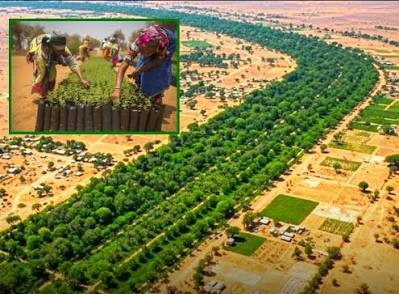
Spanning approximately 8,000 kilometres across the Sahel, a vast semi-arid region bordering the Sahara Desert, the Great Green Wall is one of the most unusual climate defence systems in the world. Over 20 countries across the continent have come together to plant more trees, restore degraded land, reverse desertification, ensure food security, and create jobs.
Stretching from the Atlantic coast of Senegal to the shores of Djibouti on the Red sea Africa is undertaking one of the most ambitious environment project ever attempted .
The Great Green Wall is an amalgamation of tree planting, with planned and phase-by-phase restoration of forests, wetlands, grasslands, farmland, and native vegetation according to local conditions. Rainwater harvesting is also part of the initiative, as is the adoption of more sustainable farming practices.
The initiative was launched by the African Union in 2007 as a long-term solution to combat climate change sweeping across the world. The renewed greenery is also expected to strengthen biodiversity across the region.
The Sahel is a vast semi-arid transitional belt of arable land in Africa that separates the arid Sahara Desert to the north from the lush savannas to the south. It connects Senegal to Djibouti. The region has been facing desertification for a long time, led by climate change and the onward march of the Sahara.
The project is still in its nascent stages but hopes to restore 100 million hectares of degraded land and remove 250 million tonnes of carbon dioxide from the atmosphere by 2030.
Approximately 30 million hectares of land have already been restored. In Senegal, 12 million drought-resistant trees have been planted, whereas in Ethiopia, 15 million hectares of degraded land have been restored.
In Nigeria and Niger, over 10 million hectares of land have been restored collectively. In Burkina Faso, 3 million hectares of land have been rehabilitated through local practices.
The project is designed to create 10 million green jobs across Africa and capture 250 million tonnes of carbon dioxide from the atmosphere .