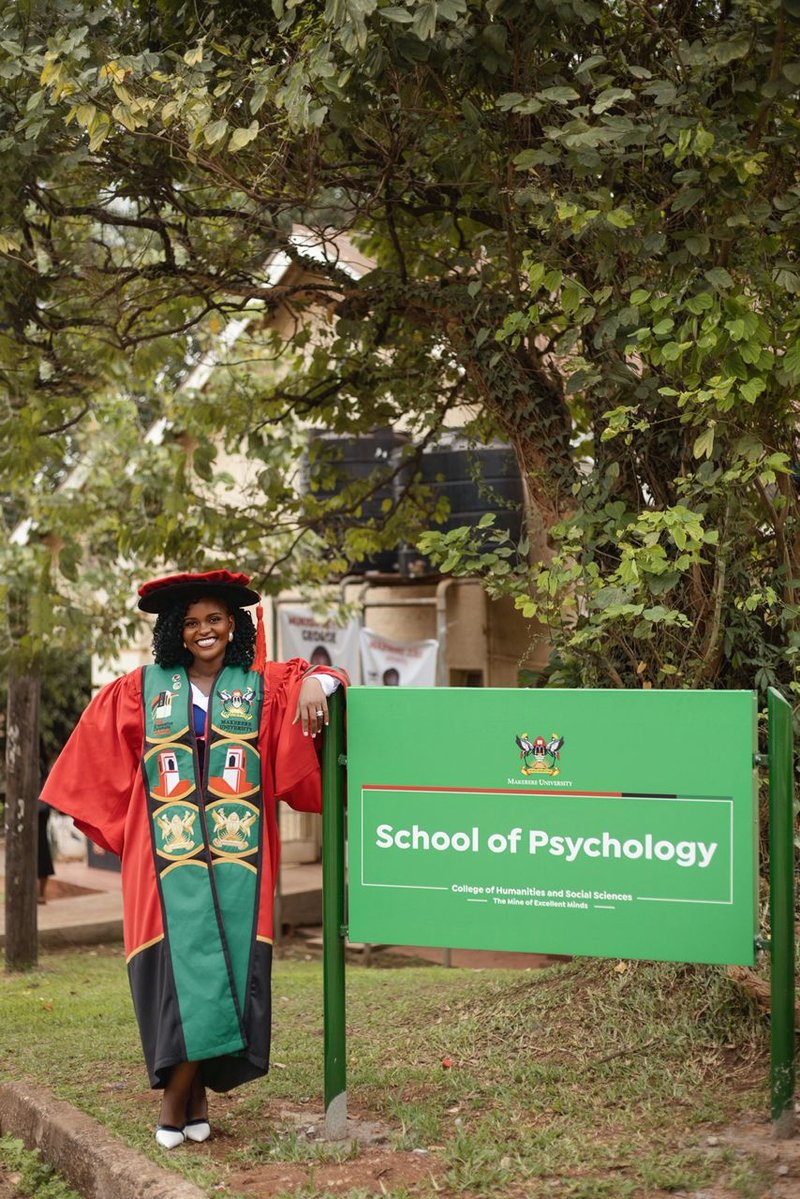
Completing a PhD at Makerere University in just two years and ten months is impressive enough. But for Dr. Irene Esther Mutuzo Sevume, the real story lies in a journey that blends intellect, creativity, and family legacy
By Fionah Agaba Barbra
At first glance, the titles stand out: lecturer, researcher, poet, AI advocate and mother. But spend a little time listening to Dr. Irene Esther Mutuzo Sevume’s story, and something even more compelling emerges.
This is the story of a young professional who refuses to be confined to a single identity; someone who has learned to weave ambition, legacy, intellect, creativity and faith into one coherent life.
If academia is often imagined as a world of dusty libraries and hushed whispers, Mutuzo is part of a new generation changing that narrative. In a feat that has drawn admiration across academic circles, she completed her PhD at Makerere University in just two years and ten months. But beyond the speed of completion lies a deeper story. From poetry stages, to research at the intersection of psychology and technology, Mutuzo represents the modern multi-hyphenate African scholar.
A legacy that began at home
Mutuzo’s connection to Makerere University began long before she ever enrolled as a student. She describes herself as having “Makerere at heart.” Raised by hardworking parents, she is the firstborn in a family of four. Academia was part of her upbringing: her father is a professor of economics, while both her grandfather and mother worked at Makerere University.
Makerere University PhD Resilience Award given to Mutuzo for having completed her PhD and excelled at it while still teaching and serving the University.
Her mother was midway through her own PhD when she tragically passed away in 2020. Mutuzo had already distinguished herself academically. She graduated with a first-class degree in Organisational Psychology, emerging as the best student in both the College of Humanities and Social Sciences and the School of Psychology. From the outside, an academic career seemed inevitable. But Mutuzo had other plans.
The corporate detour
Instead of heading straight into academia, she chose the corporate world. She worked in human resources and administration, later moving into public relations and marketing. Along the way, she gained experience with organisations including New Vision, United Bank of Africa, Greenhill Schools, and Brighter Monday Uganda.
She also explored emerging technologies, working with block chain-based initiatives such as Diwala, at a time when conversations around decentralised technologies and digital identity were still developing in Africa. Across these experiences, she found herself repeatedly involved in building or restructuring digital systems within organisations.
Gradually, a pattern became clear. The technology itself was rarely the real challenge; people were. Not because they lacked intelligence or capability, but because technology adoption is deeply psychological, emotional and cultural.
Dr. Irene Esther Mutuzo Sevume on her graduation day
She observed how digital literacy gaps shaped perceptions, how government entities hesitated around decentralisation, and how peer attitudes could influence whether systems were accepted or rejected. Without fully realising it at the time, she was gathering the questions that would later shape her doctoral research.
Returning to academia
A year after her mother’s passing, Mutuzo received an offer to teach at Makerere University in the Department of Educational, Social and Organisational Psychology. The decision was not straightforward. She was thriving in the corporate sector, and academia had never been part of her “make money and conquer the world” plan. But something deeper pulled her back.
Her mother had always believed she belonged in academia. Mutuzo had once dismissed the idea, but now it felt less like advice and more like alignment.
“One of the reasons I decided to get back into academia was to honour her legacy,” she reflects.
She accepted the position in 2022. Almost immediately, she realised how much she enjoyed teaching. Seeing former students return to say, “You taught me this, and it helped me here,” brought a sense of fulfilment she had not anticipated. The classroom began to feel less like a job and more like a calling.
Questions that led to the PhD
Mutuzo’s experience in corporate and tech environments gave her a distinctive perspective when she entered academia. She quickly noticed gaps in the curriculum, particularly around the integration of digital technologies into human resource management and organisational systems.
This led her to ask critical questions: How should universities redesign courses for a digital workplace? How can graduates be prepared for organisations increasingly driven by technology?
These questions evolved into her PhD research: “Usability, Context and the Adoption of Human Capital Management Systems in Uganda’s Public Universities: Application of the Unified Theory of Acceptance and Use of Technology”.
Her study examined the factors influencing the adoption of digital HR systems in public universities, focusing not only on technical functionality, but also on psychosocial dynamics.
The findings were revealing. People are more likely to adopt technology when they believe it adds value to their work, when it feels easy to use within their level of digital literacy, when respected colleagues support it, and when institutions provide meaningful implementation support.
Social influence proved particularly significant. If influential colleagues resist a system, others tend to follow. If trusted champions endorse it, adoption improves. Technology adoption, Mutuzo argues, is fundamentally behavioural. In a continent undergoing rapid digital transformation, understanding these dynamics is essential.
A village behind the victory
Completing a PhD in two years and ten months would be demanding under any circumstances. For Mutuzo, the journey unfolded during pregnancy and the early months of raising her new-born son. She speaks about it calmly, but the reality was intense: nights shortened by research deadlines, journal articles written between feeding schedules, and long stretches of sleep sacrificed to sustain momentum.
Her thesis exceeded 300 pages – with a proposal of nearly 150 pages – and its depth initially surprised reviewers. But she does not romanticise the process.
“It required sacrifice,” she says. “For me, it was sleep. I had to sacrifice having a normal sleep schedule for a while.”
Her motivation was deeply personal. She wanted to establish herself as an expert in digital psychology and to advocate for responsible adoption of artificial intelligence and digital systems from an African perspective. She also wanted to honour her mother’s unfinished doctoral journey.
Equally important, she emphasises that she did not do it alone. Her supervisors, Dr Martin Baluku and Prof Grace Milly Kibanja, provided consistent guidance and encouragement. Her husband supported her throughout pregnancy, postpartum recovery and the demands of doctoral work.
Dr. Mutuzo with her supervisors Dr. Martin Baluku and Prof. Grace Milly Kibanja after her defense
Her father travelled from Kabale the day before her defence and spent six hours reviewing the thesis with her, page by page. The following morning, he and her husband were both in the room at 7a.m., ready to support her during the defence.
Her siblings, parents-in-law, mentors, colleagues and friends formed what she simply calls “a village.” When asked what advice she offers young women who hope to pursue both family and career, she answers with refreshing honesty: “You will sacrifice heavily. But above all, marry wisely.” For her, marriage has been a partnership that strengthened rather than limited her ambitions.
The creative who refuses to shrink
Long before her academic career, Mutuzo was known on poetry and spoken-word stages by another name: Noisey. A performer and creative writer, she has never felt the need to silence that side of herself in order to be taken seriously in academia.
“Gone are the days when you have to be one thing,” she says. In fact, she believes creativity has strengthened her research. Poetry sharpened her writing, improved her communication skills during interviews, and influenced how she structures arguments.
For her, creativity and scholarship are not competing identities; they are mutually reinforcing. Today, her voice is increasingly part of conversations around artificial intelligence and digital responsibility.
She welcomes the possibilities of technology but urges caution about uncritical adoption. She speaks about the cognitive effects of excessive screen exposure among children, the risks of over-reliance on AI for thinking, and the possibility of digital systems reshaping human relationships in ways society has not fully considered.
Her perspective is clear: technology should remain human-centred. And Africa, she believes, must shape its own digital future rather than simply importing solutions developed in very different cultural and institutional contexts.
More than a title
For now, she is Dr. Irene Esther Mutuzo Sevume, but she hopes her legacy will extend far beyond the speed of completing a doctorate. She wants to be remembered for helping bridge psychology and technology, for advocating responsible AI use, for helping reshape education for a digital age, and for demonstrating that intellectual ambition, creativity, faith and family can coexist.
Her journey sends a powerful message to young African women watching quietly from the side lines: you do not have to choose between identities. You can be intellectual and creative; you can be a mother and ambitious; you can pursue excellence without abandoning faith.
Completing a PhD in the time that she did was remarkable. But for Mutuzo, it may only be the beginning.