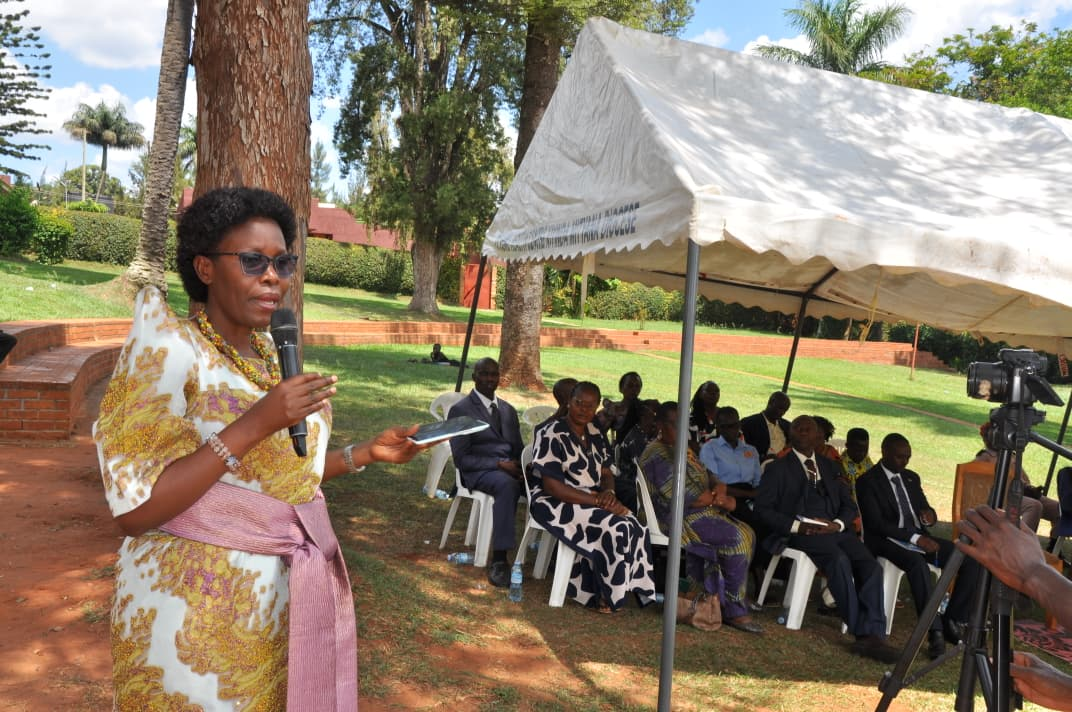
Lands Minister Judith Nabakooba has urged the Church to step up efforts to resolve family land disputes, warning that poor estate planning, inheritance disagreements and fraudulent land transactions are increasingly threatening peace in communities.
Ms Nabakooba said religious leaders were strategically positioned to educate communities about land rights, inheritance and responsible management of family property.
She made the call as Kiyinda-Mityana Diocese celebrated Justice and Peace Day on Sunday, an occasion she said should remind communities of their responsibility to promote justice, peace and respect for other people’s rights.
“Justice and freedom are the responsibility of all of us, and we must ensure that they prevail in our communities for the development of everyone,” Ms Nabakooba said.
She said justice and peace were essential for stability in families and communities, adding that the government had established laws and institutions to protect citizens against violations of their rights.
The minister urged Christians to use legal avenues to protect their rights and seek redress whenever disputes arise, including through community paralegals, village and parish leaders, the police, courts and the Equal Opportunities Commission.
Ms Nabakooba identified family property disputes as a growing source of conflict, particularly where parents die without adequately preparing their children to manage their estates.
She cited a recent case involving an 80-year-old blind man whose son allegedly attempted to sell family property despite a written will prohibiting its sale.
“It was surprising that the son had brought a tractor to clear the land even before the death of his parent. There was a written will clearly indicating that no one is allowed to sell,” she said.
She urged church leaders to use sermons and other platforms to sensitise communities about estate planning, saying proper preparation could help prevent disputes after property owners die.
“If you refuse to plan, someone else will plan for you. Planning and knowing how your property will be transferred, whether you are there or not, helps to prevent disputes and conflicts,” she said.
Ms Nabakooba also cautioned village chairpersons against abusing their offices to facilitate fraudulent land transactions, saying some were allegedly misusing official stamps to facilitate illegal deals.
“It is not written anywhere that chairpersons are the only ones who are supposed to write agreements. They misuse stamps to create fraud by selling one plot several times,” she said.
She further warned against the sale of Church property, particularly land donated to religious institutions.
The minister said some relatives of deceased donors had allegedly attempted to reclaim such property by forging letters of administration and using them to obtain land titles.
She cited a dispute in Bukalamuli village involving a school and a Church that had existed for years. According to Ms Nabakooba, a grandchild allegedly obtained a land title in 2025 and later claimed that the institutions did not exist.
She said the dispute highlighted the need for families to respect property and institutions established by previous generations.
Speaking during the celebrations, the Bishop of Kiyinda-Mityana Diocese said the responsibility for building a peaceful society began with individuals.
He urged Christians to become their “brother’s or sister’s keeper” and promote peace within their families and communities.
The bishop also called on people involved in wrongdoing to repent, saying everyone was on a journey and deserved an opportunity to change.
Mr Fredrick Ssemwanga, a lawyer from the Uganda Episcopal Conference in Kampala, said peace in families was difficult to achieve where households were not properly organised.
He identified poverty as another source of domestic conflict and urged people to work hard to improve their livelihoods.
“When a man comes home every day without money, he can become increasingly angry,” Mr Ssemwanga said.
Rev Fr Paul Keeya, the Justice and Peace coordinator at Kiyinda-Mityana Diocese, said the ministry of justice and peace was rooted in the Holy Scriptures.
He said the diocese conducted community sensitisation programmes on domestic violence, inheritance, wills and children’s rights.
Rev Fr Keeya added that the Church received numerous cases involving domestic violence and was preparing capacity-building sessions to strengthen its response.