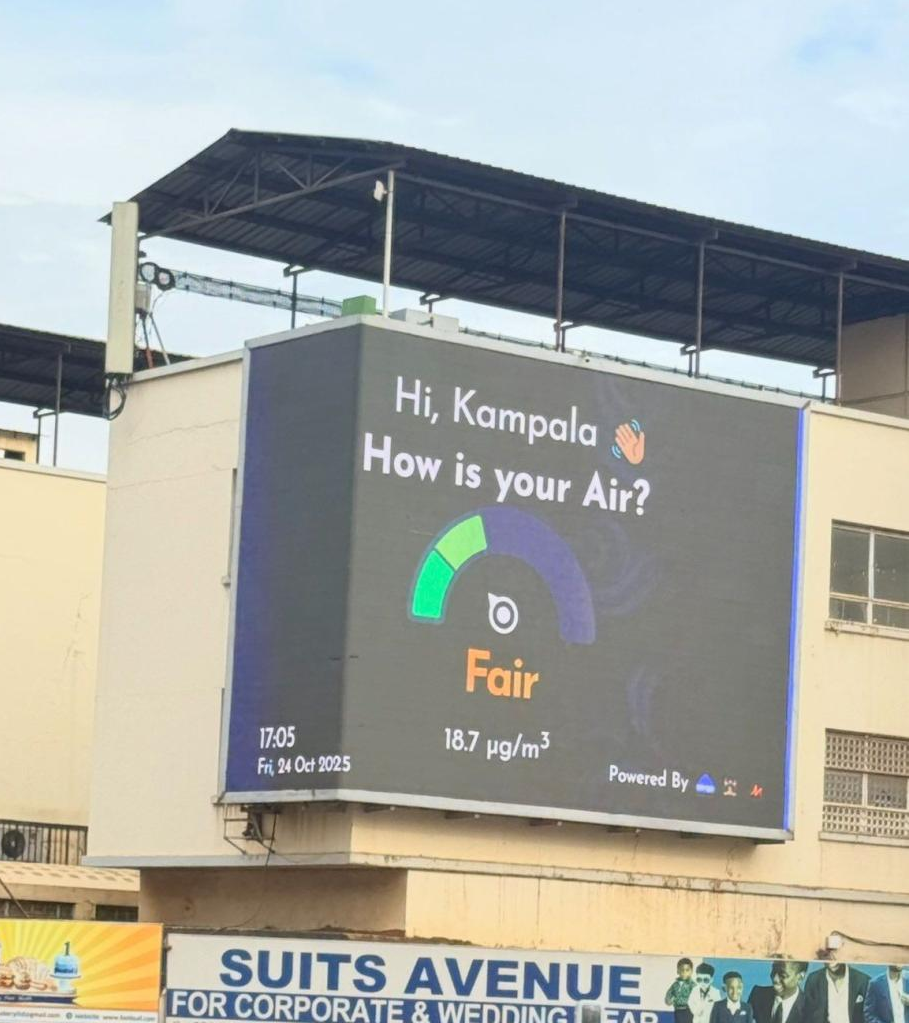
Air quality in Kampala deteriorated further in the month of November 2025, whether in terms of particles in the atmosphere, gases and noise pollution.
Data compiled around Kampala by various government and private organisations shows that particulate matter increased by 26.8 percent from 31.4µg/m³ (micrograms/cubic metre) in October 2025 to 39.8µg/m³ in November.
On the other hand, noise pollution in Kampala increased by 0.57% from 64.29 decibels in October 2025 to 64.66 decibels in November 2025, according to the data published by the Ministry of Finance, Planning and Economic Development.
”Air pollution and climate change in Uganda pose a micro-economic challenge since rapid urbanization, transport emissions and household energy choices increase health expenditures and reduce individual productivity and welfare,” says the ministry’s statement.
Monitors show that air quality in Kampala tends to deteriorate in the mornings and in the evenings, probably because of the heavy traffic congestions during rush hours.
Air pollution, primarily particulate matter (PM2.5), is one of the most serious contemporary health threats globally, causing over 7 million premature deaths annually, according to the World Health Organisation (WHO).
Particulate matter (PM) refers to tiny particles or droplets – less than 2.5 micrometres in diameter – in the air that can be inhaled and cause health issues. They can come from pollution, smoke, dust, or even wildfires.
The 2024 World Air Quality Report ranked Uganda as the 8th most polluted country globally with particulate matter at 41µg/m³.
Kampala Capital City Authority (KCCA) has, as part of its efforts against air quality, installed about 100 air quality monitors across the five city divisions and trained “air quality champions” to lead the efforts at the grassroots.
Most reports point at air pollution by vehicles, followed by dust, factory emissions and poor garbage disposal.
A random check on December 26, 2025 showed a drastic improvement in air quality in Kampala compared to the previous weeks, to particulate matter content of less than 18.46µg/m³ down from 40µg/m³.
Particulate matter of less than 10 microns in size were found at a low 27.9 micrograms per cubic metre, while nitrogen dioxide and sulphur dioxide were also found to be very low in the air.
The conclusion was that it was because of the very few vehicles on the streets due to the season’s holiday when most people travel upcountry. This is expected to have led to less emissions and dust.
The Fourth National Development Plan (NDPIV) emphasizes the need to improve
air quality by reducing the annual average air pollution level from 41µg/m³ in financial year 2024/25 to 5µg/m³ by 2029/30.
The statement says that to achieve this, Government has strengthened and enforced the legal and regulatory frameworks by implementing the National Environment (Air Quality Standards) regulations, 2024.
These regulations prohibit harmful emission from objectionable matter or obnoxious smells including smoke, gases, vapours, fumes, dust or other matter capable of being dispersed or suspended in the atmosphere.
In addition, they prohibit a person from causing emissions into the air beyond permissible limits.
The Kampala Health and Pollution Action Plan (HPAP) recently launched under the Environmental Pollution Programme in Uganda (EPP-UG) recently aims at tackling issues related to pollution including vehicle emissions, industrial activities, domestic and municipal waste, medical and mining byproducts and construction debris.
Among other approaches, for example, Government is enforcing the EURO 4/IV vehicle emissions standard of the East Africa Community that prohibits importation of vehicles that are more than 15 years old, helping to reduce urban air pollution.
The National Energy Policy 2023 is also expected to help reduce on emissions through enhancing the use of clean energy such as the Liquefied Petroleum Gas n order to reduce reliance on charcoal and its associated environmental and health impacts.
Government has also established low-cost monitoring stations by AirQo in urban areas, including high-resolution systems that have been deployed in Kampala, Jinja, Fort Portal, Kira, and Kabale to monitor air quality.
The ministry of water and environment says that as of December 2024, Uganda had over 171 air quality monitoring sites across all its regions.
The National Environment Management Authority (NEMA) is also working with KCCA and Makerere University AirQo to establish a network of sensors in
various parts of the country, to get more accurate records for the whole country.
KCCA Executive Director, Sharifah Buzeki, recently told a delegation from Dhaka, Bangladesh, under the Partnership for Healthy Cities, that the investment is a community-led monitoring initiative that places “air quality champions” at the heart of neighbourhood-level surveillance.
Each cell or village has at least four trained champions responsible for collecting real-time air quality information and reporting emerging concerns to ensure “timely interventions”.
She said that KCCA was also implementing a set of public health and environmental regulations designed to cut down human exposure to harmful pollutants, like the promotion of a smoke-free Kampala.
Among the interventions are enforcing restrictions on public smoking and intensifying efforts to discourage the open burning of waste, which is common especially in Kampala’s crowded settlements.
”From expanding air quality monitoring and greening our city, to enforcing vehicle inspections, paving more roads to reduce dust, and investing in non-motorised transport, KCCA is committed to ensuring cleaner air. But lasting change happens when every resident gets involved,” says Buzeki.
According to Eng Julian Tabaro, a climate change analyst, in Kampala on average, a person takes in bad air equivalent to at least 5 sticks of cigarette a day.
”22 micrograms PM 2.5 is equivalent to 1 cigarette per day. Now imagine in Kampala where we even go to 100 PM 2.5 on some days throughout the day! In a day you have smoked over several cigarettes unintended”, she says.