Sweden supported refugee students in Uganda’s Kamwenge build confidence and digital skills
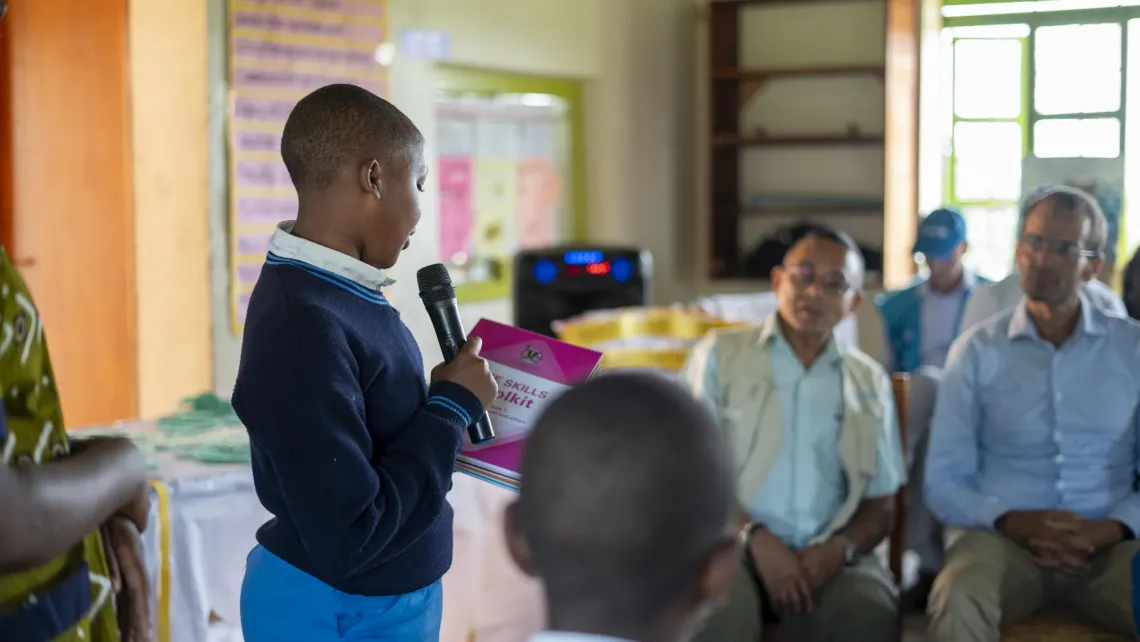
On a Friday afternoon, Keria Akeza, a Congolese refugee student in Senior 2 West at Rwamwanja Secondary School (SS) in Uganda’s southwestern district of Kamwenge, led her 40-member cohort in a dynamic presentation to showcase the knowledge gained at their Life Skills Club for adolescents. Before joining the club, Akeza lacked self-esteem; she was withdrawn and could not speak in public and was wary of people because of her refugee status.
At Rwamwanja SS, there are many such refugee students from the war-affected neighbouring countries of the Democratic Republic of Congo, Sudan and South Sudan. The school is one of the twelve government-aided secondary schools in Kamwenge and is in the Rwamwanja Refugee Settlement in Nkoma Katarebwa Town Council. It has a total population of 1,840 students (1,011 nationals and 829 refugees).
The Life Skills Club began in 2022 with funds provided by the Swedish Government through UNICEF to equip adolescent students with survival skills derived from ten competencies. Over 160 students have benefited so far. In addition, the Swedish Government through UNICEF is supporting the Integrated Adolescent Health Outreach (IAHO) programme, which incorporates 21st-century skills (life skills and digital learning).
The Life Skills Club is run by two patrons, Joan Nambi and Laban Rubongoya, who have themselves benefited from a similar programme supported by UNICEF. When training the students, Nambi and Rubongoya use a UNICEF life-skills toolkit manual for adolescents (boys and girls).
“We want our students to grow up knowing the community values of love, hard work, self-respect and respect for others, especially the refugees who constitute half of the population in the district. We teach them to have respect for girl children and be innovative.”Oscar Ntwatwa, says the headteacher at Rwamwanja SS.
On 6 November 2025, a delegation of eight Swedish MPs, who have been in Uganda on a fact-finding mission to assess firsthand the impact of Official Development Assistance (ODA) extended to Uganda by the Swedish Government, visited Rwamwanja SS and were entertained to a colourful presentation by student members of the Life Skills Club.
The MPs, representing eight political parties in Sweden, included Katrina Tolgfors, Martina Johansson, Magnus Berntsson, Yasmine Eriksson, Joar Forsell, Janine Alm Ericson, Markus Kauppinen and Andreas Lennkvist Manriquez. They were accompanied by two staff members from UNICEF Sweden, Karin Strömstedt and Erik Windmar. In Kamwenge, they were joined by UNICEF Country Representative to Uganda, Dr Robin Nandy; Chief of Child Survival and Development, UNICEF Uganda, Dr Yaron Wolman; and the Counsellor, Deputy Head of Mission and Head of Cooperation, Embassy of Sweden, Adam Kahsai Rudebeck.
Akeza was joined by Henry Murungi and Chancelline Faida to lead their 40-member cohort in a presentation about the skills they had so far acquired at the Life Skills Club. The students told the Swedish MPs that the club has seven modules taught in 39 sessions over a period of one year before graduation. The modules include knowing myself and others; my body; my health; let’s talk it out; staying safe and healthy; my opportunities; my plans; our community; and our innovations.
“In these seven modules, the adolescents at Rwamwanja SS are equipped with ten competencies: identity and self-esteem, cooperation and teamwork, critical thinking and decision-making, communication, and expression. We learn how to cope with stress and manage emotions, empathy and respect, problem-solving and managing conflicts. We have set goals and hope for the future and have learned how to be creative and innovative with leadership and influence.”Rwamwanja S S students said ,amid applause from the visiting MPs
Nambi said that the club enrols adolescents between the ages of 10 and 19 years and helps them to overcome everyday growth challenges. “We train them using the life-skills toolkit that was given to us by UNICEF. There are two cohorts that have graduated, and the third cohort is on module four,” she stated.
At the school’s digital lab, led by Owen Mukwomezi and Joachim Bwambale, the learners identify societal problems and develop digital solutions. Learning under the hashtag ‘digital students champions of change’, the students are introduced to digital skills, communication and collaboration, information sharing, information safety and security, and programming.
“Our students have already come up with different digital solutions to a number of problems, including a report card system and election and school fees management systems,” Mukwomezi stated.
“The school also offers an Accelerated Education Programme (AEP) for refugee students who have been out of school and are overage for their classes. Thanks to support from UNHCR and other partners, the school’s academic performance has significantly improved. Our students have progressed to higher institutions both locally and internationally, especially through scholarships for refugee learners,” Ntwatwa said.
Dr William Mucunguzi, the UNICEF Focal Person in Kamwenge, said that given the UNICEF-supported intervention in the district’s education sector, there has been marked improvement in learning outcomes.
“The Primary Leaving Examination (PLE) pass rate improved from 93.3 per cent in 2023 to 96.2 per cent in 2024, and the P.3 numeracy proficiency improved from 58.8 per cent in 2018 to 65.1 per cent in 2024. We continue to strengthen life-skills education that boosts pupils’ confidence and teamwork. At least 60 out of the 85 primary government schools are benefiting from the Life Skills Toolkit developed by UNICEF, which is empowering adolescents with 21st-century skills,” he said, adding that 13 per cent of secondary schools with functional computer labs have adopted digital learning platforms, aligning with emerging educational trends and supporting blended learning.
Sanitation improvements, particularly in household and school Water, Sanitation, and Hygiene (WASH), have contributed to increased school attendance. Girls, in particular, benefit from improved privacy and menstrual hygiene management, resulting in fewer school dropouts and improved performance. Schools supported through hygiene education sessions and sanitation promotion report greater participation and lower absenteeism among adolescent girls.
“UNICEF-supported interventions have triggered a cascade of positive, interconnected outcomes, acting as a catalyst for broader development and system resilience,” Dr Mucunguzi said.
Sustainability strategies
Dr Mucunguzi explained that to ensure sustainability, the life-skills toolkit training has been incorporated into the new curriculum. “We have also adopted digital data-collection methods for evidence-based decision making,” he added.
The UNICEF Representative to Uganda, Dr. Robin Nandy, urged the students to take their studies seriously in order to become responsible citizens.