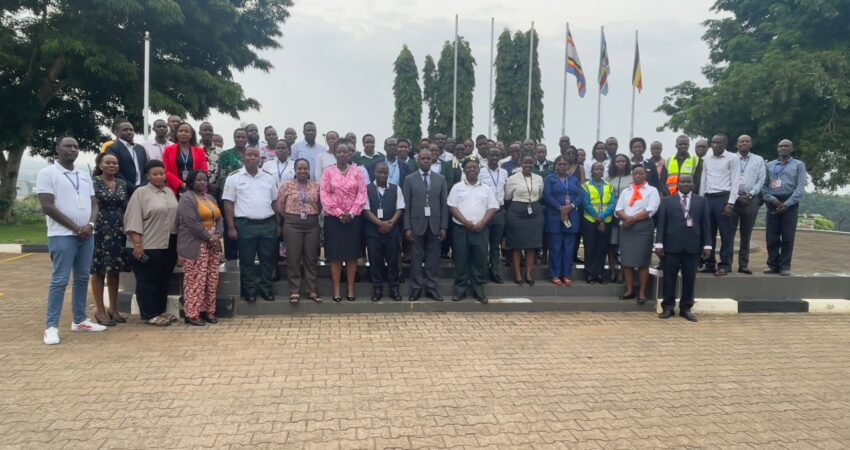
Uganda Civil Aviation Aughority (UCAA), in collaboration with the Directorate of Citizenship and Immigration Control has conducted a fraud detection and travel document inspection training for airline operators, ground handlers, security agencies and UCAA staff at the UCAA head office in Entebbe.
The training aligns with ICAO Annex 9 – Facilitation standards and strengthens Uganda’s compliance under the USAP-CMA framework. Over 60 participants were equipped with tools to detect red flags, identify security features in travel documents, and enhance collaboration in preventing fraud.
Mr. Christopher Kasozi, Manager Economic Regulation at UCAA, delivered the welcome remarks on behalf of the Director of Safety, Security and Economic Regulation. He emphasized that the training was conducted in compliance with Standard 3.33 of Annex 9 – Facilitation to the Chicago Convention, to which Uganda is a signatory.
Following the domestication of Annex 9 under the National Air Transport Facilitation Programme, the Directorate of Citizenship and Immigration Control (DCIC), in the discharge of its mandate of inspecting travel documents, is responsible for assisting aircraft operators in the evaluation of passports and other travel documents presented by passengers in order to deter fraud and abuse.
He added that this area falls under the ICAO Universal Security Audit Programme – Continuous Monitoring Approach (USAP-CMA), specifically within the auditable areas of Annex 9 – Facilitation. Uganda was assessed using Protocol Question 9.040 during the 2024 audit and was found to be compliant.
Mr. Macellino Bwesigye, Assistant Commissioner for Border and Foreign Nationals Management at the Directorate of Citizenship and Immigration Control, officially opened the training. He thanked UCAA and DCIC for organizing the important session and emphasized the following key objectives: Building awareness of fraud risks specific to airline operations, equipping participants with tools for fraud detection and prevention, strengthening collaboration among stakeholders and promoting a proactive culture in managing fraud risks.
Further ,the training was also intended to equip participants with techniques to detect red flags and suspicious activity and sharing best practices for prevention and response