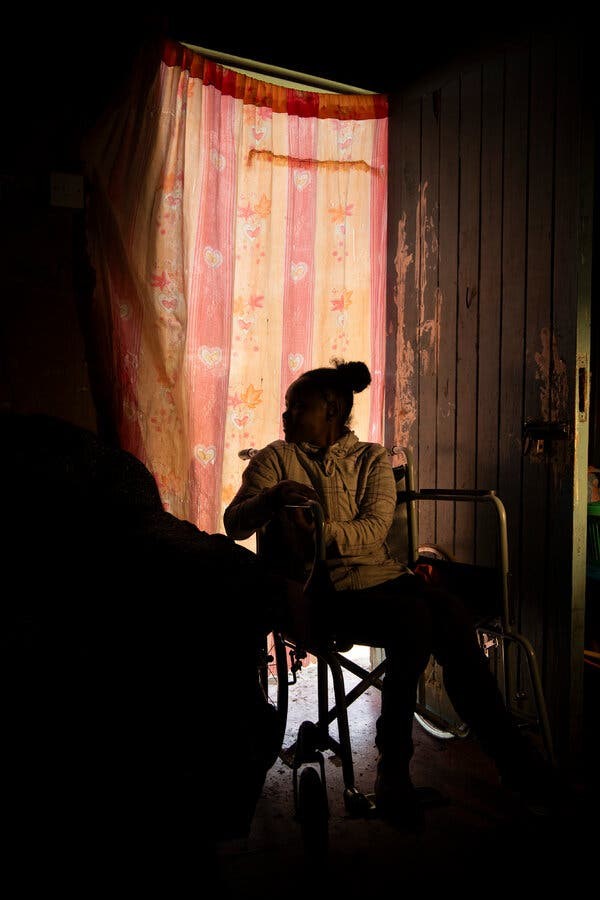
Abdi Latif Dahir, Justin Scheck and Kiana Hayeri spent months visiting cities and remote villages in Kenya and Uganda.
On any given day in Kenya, dozens, if not hundreds of women buzz around the Nairobi international airport’s departures area. They huddle for selfies in matching T-shirts, discussing how they’ll spend the money from their new jobs in Saudi Arabia.
Lured by company recruiters and encouraged by Kenya’s government, the women have reason for optimism. Spend two years in Saudi Arabia as a housekeeper or nanny, the pitch goes, and you can earn enough to build a house, educate your children and save for the future.
While the departure terminal hums with anticipation, the arrivals area is where hope meets grim reality. Hollow-cheeked women return, often ground down by unpaid wages, beatings, starvation and sexual assault. Some are broke. Others are in coffins.
At least 274 Kenyan workers, mostly women, have died in Saudi Arabia in the past five years — an extraordinary figure for a young work force doing jobs that, in most countries, are considered extremely safe. At least 55 Kenyan workers died last year, twice as many as the previous year.
Autopsy reports are vague and contradictory. They describe women with evidence of trauma, including burns and electric shocks, all labeled natural deaths. One woman’s cause of death was simply “brain dead.” An untold number of Ugandans have died, too, but their government releases no data.
There are people who are supposed to protect these women — government officials like some who sit on the labor committee in Kenya’s National Assembly. The powerful committee could demand thorough investigations into worker deaths, pressure the government to negotiate better protections from Saudi Arabia or pass laws limiting migration until reforms are enacted.
But some of these officials also own staffing companies that send women to Saudi Arabia. One of them, Margaret Mutheu Mueni, said that her Saudi boss had seized her passport, declared that he had “bought” her and frequently withheld food. When she called the staffing agency for help, she said, a company representative told her, “You can swim across the Red Sea and get yourself back to Kenya.”
In Kenya, Uganda and Saudi Arabia, a New York Times investigation found, powerful people have incentives to keep the flow of workers moving, despite widespread abuse.
Early this year , four Ugandan women in maids’ uniforms sent a video plea to an aid group, saying that they had been detained for six months in Saudi Arabia.
“We are exhausted from being held against our will,” one woman said on the video. The company that sent her abroad is owned by Sedrack Nzaire, an official with Uganda’s governing party who is identified in Ugandan media as the brother of the president, Yoweri Museveni.
Nearly every staffing agency refused to answer questions or ignored repeated requests for comment.
In Kenya and Uganda remittances from foreign workers are a significant source of income. Even after other countries negotiated deals with Saudi Arabia that guaranteed worker protections, East African countries missed opportunities to do the same, records show.
Kenya’s Commission on Administrative Justice declared in 2022 that worker-protection efforts had been hindered by “interference by politicians who use proxies to operate the agencies.”
A Kenyan housekeeper, Eunice Achieng, called home in a panic in 2022, saying that her boss had threatened to kill her and throw her in a water tank. “She was screaming, ‘Please come save me!’” her mother recalled. Ms. Achieng soon turned up dead in a rooftop water tank, her mother said. Saudi health officials said her body was too decomposed to determine how she died. The Saudi police labeled it a “natural death.”
One young mother jumped from a third-story roof to escape an abusive employer, breaking her back. Another said that her boss had raped her and then sent her home pregnant and broke.
In Uganda, Isiko Moses Waiswa said that when he learned his wife had died in Saudi Arabia, her employer there gave him a choice: her body or her $2,800 in wages.
“I told him that whether you send me the money or you don’t send me the money, me, I want the body of my wife,” Mr. Waiswa said.
A Saudi autopsy found that his wife, Aisha Meeme, was emaciated. She had extensive bruising, three broken ribs and what appeared to be severe electrocution burns on her ear, hand and feet. The Saudi authorities declared that she had died of natural causes.
Roughly half a million Kenyan and Ugandan workers are in Saudi Arabia today, the Saudi government says. Most of them are women who cook, clean or care for children. Journalists and rights groups, who have long publicized worker abuse in the kingdom, have often blamed its persistence on archaic Saudi labor laws.
The Times interviewed more than 90 workers and family members of those who died, and uncovered another reason that things do not change. Using employment contracts, medical files and autopsies, reporters linked deaths and injuries to staffing agencies and the people who run them. What became clear was that powerful people profit off the system as it exists.
The interviews and documents reveal a system that treats women like household goods — bought, sold and discarded. Some company websites have an “add to cart” button next to photos of workers. One advertises “Kenyan maids for sale.”
A spokesman for the human resources ministry in Saudi Arabia said it had taken steps to protect workers. “Any form of exploitation or abuse of domestic workers is entirely unacceptable, and allegations of such behavior are thoroughly investigated,” the spokesman, Mike Goldstein, wrote in an email.
He said the government had raised fines for abuse and made it easier for workers to quit. He said domestic laborers were capped at 10-hour workdays and were guaranteed one day off per week. He said the government now requires employers to pay their maids through an online system and will one day track people who repeatedly violate labor laws.
“Workers have multiple ways to report abuse, unpaid wages or contract violations, including hotlines, digital platforms and direct complaint mechanisms,” he said.
But Milton Turyasiima, an assistant commissioner with the Ugandan Ministry of Gender, Labor and Social Development, said that abuse remained rampant. “We get complaints on a daily basis,” he said.
Selling a Dream
Recruiters fan out across East Africa, from impoverished hilltop villages to the cinder block neighborhoods of Nairobi and Kampala, the Ugandan capital.
They search for people desperate, and ambitious, enough to leave their families for low-paying jobs in a country where they do not know the native language. People like Faridah Nassanga, a slim woman with a warm but detached air.
“We are really poor,” Ms. Nassanga said, sitting outside her one-room concrete home in Kampala. Meals are cooked on a propane burner in the alley beside a trickling sewage gutter. She shares a triple-decker bunk bed with her mother and children.
Ms. Nassanga said a friend introduced her in 2019 to an agent. Ms. Nassanga agreed to move to Saudi Arabia for a job paying about $200 a month.
She found her housekeeping job as pleasant as recruiters had promised. She had her own room. The woman she worked for sometimes even helped with chores.
Then one day, she said, her boss’s husband walked into her room and raped her. Afterward, she said, he kicked and slapped her. He threw her underwear at her as she retreated to the kitchen, Ms. Nassanga said.
When she became pregnant, Ms. Nassanga’s boss accused her of sleeping with the husband. The Saudi family put her on a plane back to Uganda, said Abdallah Kayonde, who runs a legal-aid group that is trying to get compensation for her.
Ms. Nassanga knows her employer’s name but not her phone number. The only records she has are from the recruiting agency.
Now, Ms. Nassanga is back sharing a one-room home with her mother, her two older children and her toddler — a boy with a notably different complexion and hair from his siblings.
‘An Important Destination Country’
Saudi Arabia has a wage hierarchy for foreign workers, with East Africans near the bottom at about $200 to $250 a month.
Over the years, some countries have fought for better wages and protections for their workers. The Philippines, for example, negotiated a deal with Saudi Arabia in 2012 that raised wages.
That sent staffing agencies looking for cheaper labor elsewhere.
Few Ugandan workers arrived in the kingdom in 2017, Ugandan government data show. Five years later, the number was 85,928.
African governments stood to benefit from remittances.
Josephine Uchi says she worked a demanding housekeeping job while also caring for a Saudi family of 12. She was allowed four hours of sleep a night.
The African countries provide a “new and lower-cost services market,” one of Saudi Arabia’s largest staffing agencies, Maharah Human Resources Company, wrote in 2019.
(East African recruiting agencies make money from per-worker fees from Saudi companies. Those companies, in turn, get fees from people who hire maids.)
Mary Nsiimenta, a single mother with big, mournful eyes, cleaned house for a family with five children in Najran, in southern Saudi Arabia. She said the children, ages 9 to 18, hit her with a stick and put bleach in her eyes.
(Several women told The Times that they were assaulted with bleach or forced to soak their hands in it as punishment.)
According to Ms. Nsiimenta, her employer was stingy with her salary. After she repeatedly asked to be paid, she said, the family locked her on a third-story rooftop.
As time dragged on, she felt sure she would die there, she recalled. “The sun was too much,” she said. “Hot. No food. I lost control.” She jumped, landing hard.
“I crawled out like a snake” to the street, she said. Passers-by took her to a hospital where, medical records show, doctors repaired her spine. She reported the abuse to doctors and the police, she said, but they told her to return to work.
Ms. Nsiimenta refused, and the Saudi placement agency returned her to Uganda in 2023. In chronic pain and incontinent, she cannot work. Friends and relatives are raising her children. “My life is destroyed,” she said.
Trading Abuse for a Type of Prison
Saudi law says that, when a worker needs to go home, an employer, recruiter or the Saudi government is obligated to pay. “Under no circumstances does a worker bear any financial responsibility for repatriation,” wrote Mr. Goldstein, the Saudi ministry spokesman.
But workers and worker-rights advocates say that laborers are often forced to pay. Those without money can be detained.
Because visas are tied to employment, workers who leave their jobs can lose their legal status. To help address that, the Saudi government paid a company, Sakan, to provide housing and legal assistance to foreign workers in trouble.
Hannah Njeri Miriam ended up at a Sakan center in 2022, about a year after she left Kenya’s Rift Valley for Saudi Arabia.
Ms. Miriam’s employer fired her after a dispute. Jobless and homeless, Sakan was the only place to go. Once there, according to her family, the staff said she could leave only if she paid about $300 for her travel.
She called home, saying she was being mistreated and underfed. Nobody could afford to help. The Kenyan agency that had sent her abroad had gone out of business.
Finally, her family got a call from another woman at the center. She said Ms. Miriam had tried to escape through an air-conditioning opening but had slipped and fallen two stories. A forensic report said that Ms. Miriam had died of head wounds. The Saudi police later said that she died of “congestive cardiac and respiratory failure.” Sakan’s chairman declined to comment.
Mr. Goldstein, the Saudi ministry spokesman, declined to comment on individual deaths but said that every case was thoroughly investigated. He did not comment on the inconsistencies between autopsies and police reports and would not say how many people had been arrested or prosecuted in labor cases.
Mr. Goldstein said the government stopped funding Sakan in 2023. Now, he said, it pays the recruiting agency Smasco to run worker-assistance centers.
Three Kenyan women spoke to The Times from inside a Smasco center. The women, who spoke on the condition of anonymity for fear of retaliation, said that they could not go home unless they paid about $400. The company did not respond to requests for comment.
Returning Home
As migration to Saudi Arabia surged, reports of deaths and injuries spread across East Africa. Bodies began arriving. Each story brought new outrage.
People should not have been surprised. The leaders of Kenya and Uganda had ample warning of abuse, yet they signed agreements with Saudi Arabia that lacked protections that other leaders demanded.
The Philippines deal in 2012, for example, guaranteed a $400 monthly minimum wage, access to bank accounts and a promise that workers’ passports would not be confiscated.
Kenya initially demanded similar wages, according to a government report, but when Saudi Arabia balked, Kenya agreed to a deal in 2015 with no minimum wage at all.
The treaty contained little beyond a promise to establish a committee to monitor labor issues. The commission was never formed, a government report said.
Mr. Mohamed, the Kenyan president’s spokesman, said that the government later negotiated $225 monthly wages. He said Kenyan workers were simply not as highly regarded in Saudi Arabia. “Philippines is able to dictate the price,” he said.
When Uganda cut its agreement with the Saudi government, they made no mention of a minimum wage. The issue of worker mistreatment was well discussed at the time. The Saudi ambassador to Uganda even wrote a column in a Ugandan newspaper assailing critics who “offend and abuse the Kingdom of Saudi Arabia” by publicizing abuse.
Now, a few times a month, rural Kenyans head to Nairobi to collect a coffin from the airport.
Hundreds of people gathered in September at a village school in southwestern Kenya. They paid respects to Millicent Moraa Obwocha, who had left her husband and young son behind months earlier.
Her employer sexually harassed and assaulted her, her husband, Obuya Simon Areba, said. Things got so bad last summer, he said, that she asked her Saudi recruiter to rescue her.
A few days later, her husband got the call that she was dead. She was 24. The Kenyan government attributed her death to “nerve issues.”
At the funeral, Ms. Obwocha’s body lay in an open coffin in a white dress and veil.
Beside her was a six-foot-tall photograph. In it, she smiles with her fingers held up in a V. She is standing outside the airport, brimming with optimism.
Editor”s note :this aticlewas first published by the New York Times