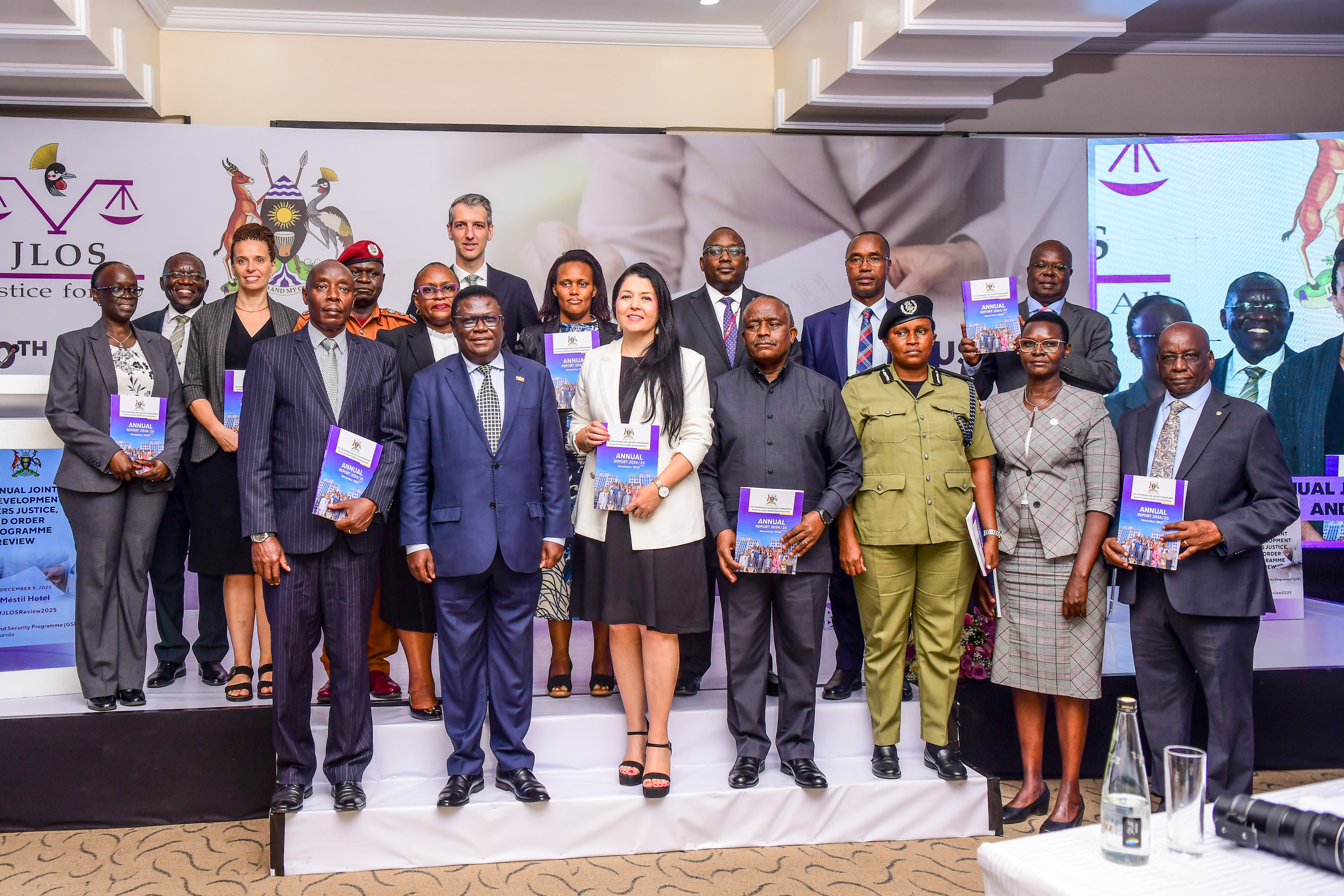
Justice Minister Nobert Mao has condemned the recent campaign violence in some parts of the country including the bloody incidents in Gulu and Kamuli and called upon the security agents and the Electoral Commission to aarrest and prosecute the parpetuators .
The Electoral Commission must take charge and bring to book the perpetuators of election violence. You cannot say you are waiting for police reports when the perpetrators are visible and identifiable “, Mao stated .
The Minister also expressed concern at the arbitrary arrests and long detention of suspects without being take to court and or formally charged for alleged offences committed.
Mao was giving a key note address during launch of the 30th Annual Report on Security, Governance and Justice in Uganda, which highlights ongoing challenges in the justice system, including ;prolonged pretrial detention, case backlog across civilian courts, gaps in transitional justice mechanisms, and weak accountability for security-related human rights violations.
Justice Minister Mao with Dr.Dr. Katja Kerschbaumer
The Permanent Secretary, Ministry of Justice and Constitutional Affairs , Mr. Robert Kasande said that 30th Justice Law and Order sub-programme Annual Performance Report for the Financial Year 2024/25, was the 5th performance report under the programme-based approach and the final report under the National Development Plan III.
“This report represents the collective progress of all institutions under the Justice, Law, and Order Sub-programme framework. It reflects our joint achievements, our shared challenges, and our continuing commitment to building a people-centred justice system that promotes the rule of law, human rights, and access to justice for all,” Kasande told the gathering.
The PS noted that over the past year, JLOS has continued to implement key reforms in criminal justice, commercial justice, land justice, and access to justice for vulnerable groups.
Some of the significant strides made include digitalisation and automation of justice systems; infrastructure development, including the near completion of the JLOS House; innovations in community justice and child protection; and strengthened coordination among institutions for improved case management and service delivery.
“These achievements were made possible through the steadfast partnership between the government, development partners, and civil society organisations, all working under the JLOS umbrella,” he added.
Justice Ministry Under Secretary , Dr. Emmanuel Mugunga
Mr. Pius Perry Biribonwoha , the learned Solicitor General , said the report was a reflection of the entire resource envelope for the JLOS institutions which includes the SWAP basket fund, government of Uganda recurrent and development expenditure as well as other multilateral and bilateral project support that the sub-programme institutions accessed during the FY 2024/25.
Biribonwoha thanked the JLOS development partners who continue to support the sub-programme in various forms- specifically noting the European Union ; the government of Austria , UNICEF – support towards implementation of the Justice for children project, UNFPA – support towards the sexual and gender based violence special sessions; IDLO (With Support from Sweden) ; community justice programme and (with support from the Netherlands – access to justice for sustainable development programme and UN-Women project support.
The head of Austrian Embassy and development cooperation who is also chairperson of the Justice Sector Development Partners’ Group, Dr. Katja Kerschbaumer, noted that access to justice remains the cornerstone of a fair and inclusive society, and without it, rights risk becoming symbolic rather than real, and inequalities deepen.
Empowering the People
She emphasised that the rule of law empowers citizens by enabling them to seek redress and challenge injustices.” Legal empowerment strengthens civic participation, encourages accountability, and offers protections against arbitrary actions,” she said.
Dr. Kerschbaumer called for the establishment of a national legal aid framework noting that the absence of an enacted Legal Aid law continues to limit equal access to justice, particularly for vulnerable and marginalized groups.
She said that the development partners were happy with improved case disposal rates, continued automation of justice services, increased diversion of juveniles, ongoing reforms in JLOS business processes, and the broader application of human rights-based approaches.
Dr. Kerschbaumer ,however hastened to add that there are still persistent challenges which include case backlog that impedes timely access to justice.
“Remand times remain long and require urgent attention.Prison congestion is severe and needs sustained reforms and investment and gaps in coordination across institutions affect timely hearings and communication with beneficiaries,” stated .
Addressing these challenges , according to the development partners will significantly improve the efficiency, credibility, and accessibility of the justice chain.