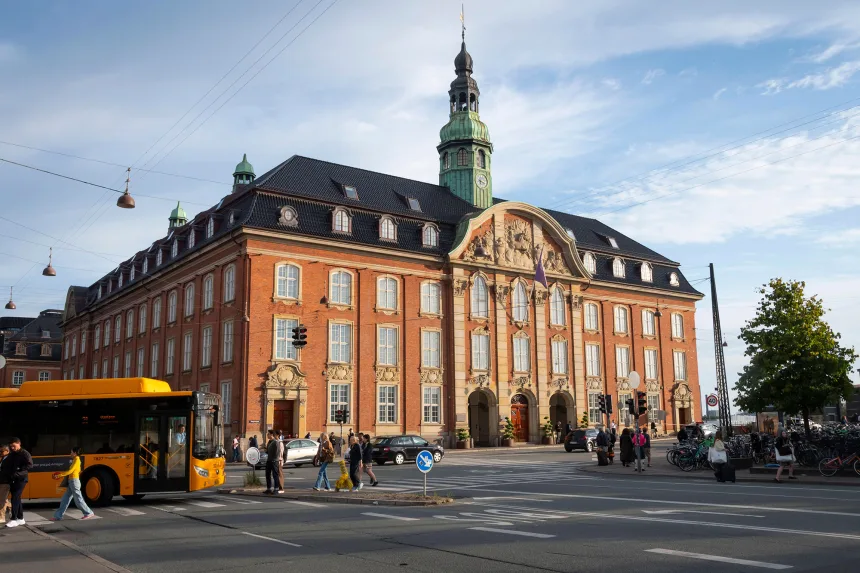
Beside the railroad tracks of Copenhagen’s train station, right in the heart of the Danish capital, stands a red-brick building with an ornate façade and a copper-clad cupola still turning green over time.
When it opened in 1912 as the Central Post Building, its grandeur echoed the booming postal and telegraph services that crisscrossed Denmark, connecting Danes to one another. A little over a century later and that building, now a luxury hotel, presides over a city, and a country, where the postal service no longer delivers letters.
Denmark’s state-run postal service, PostNord, will deliver its last ever letter on Tuesday, as the digital age brings its 400-year-run to an end. This makes Denmark the first country in the world to decide that physical mail is no longer either essential or economically viable.
The precipitous decline of a national postal service is a familiar story, one echoed elsewhere in the Western world as we rely ever more heavily on digital means of communication.
Denmark’s postal service delivered more than 90% fewer letters in 2024 than in 2000. The US Postal Service delivered 50% less mail in 2024 than in 2006.
And as our correspondence has moved largely online – transfiguring into WhatsApp messages, video calls, or just an exchange of memes – our communication and language have changed accordingly.
Letters themselves “will change status” too, often coming to represent more intimate messages than their digital counterparts, said Dirk van Miert, a professor at the Huygens Institute in the Netherlands who specializes in early modern knowledge networks.
The knowledge networks that letters facilitated for centuries are “only expanding” in their online form, expediting both access to that knowledge as well as the rise of disinformation, he told CNN.
No more mailboxes
PostNord has been removing the 1,500 mailboxes scattered across Denmark since June. When it sold them off to raise money for charity on December 10, hundreds of thousands of Danes tried to buy one. For each mailbox, they paid either 2,000 ($315) or 1,500 ($236) Danish krone, depending on how worn they were.
Instead of posting letters, Danes will now have to drop them off at kiosks in shops, from where they will be couriered by private company DAO to both domestic and international addresses. PostNord will continue delivering parcels, however, as online shopping remains ever popular.
Denmark is one of the world’s most digital nations; even its public sector utilizes several online portals, minimizing any physical government correspondence and making it much less reliant on postal services than many other countries.
“Almost every Dane is fully digital, meaning physical letters no longer serve the same purpose as previously,” Andreas Brethvad, a spokesperson for PostNord, told media. “Most communication now arrives in our electronic mailboxes, and the reality today is that e-commerce and the parcel market far outweigh traditional mail.”
That may explain why it is the first country to make these changes, though it seems likely others will eventually follow. Van Miert, who lives in the Netherlands, said he had to go to a shop to post letters because there are no longer any mailboxes in his town.
Still, the need for physical correspondence continues around the world, even if it is diminished. Almost 2.6 billion people remain offline, according to the UN-affiliated Universal Postal Union, and many more “lack meaningful connectivity,” thanks to inadequate devices, poor coverage and limited digital skills. Rural communities, women and those living in poverty are among the worst affected, it added.
And even in countries like Denmark, some groups who are more reliant on postal services, like older people, may be adversely affected by the changes, advocacy groups say.
“It’s very easy for us to access our mail on the phone or a website… but we forgot to give the same possibilities to those who are not digital,” said Marlene Rishoej Cordes, a spokesperson for the DaneAge Association, which advocates for older people.
She told CNN that DAO, the new postal courier, has a service where it will collect mail at a home address but “it still demands you are digital because you have to pay for this service and you can only pay digitally.”
‘Whatever channel we have’
The letter has undergone transformations before, in both medium and style. “It changed formats from papyrus or wax tablets… then paper later on, vellum in the Middle Ages, and now we have electronic devices,” said Van Miert.
In the 17th century, following the traditions laid down by great philosopher-letter-writers, like Cicero and Erasmus, students were taught “how to write a proper letter, a letter of consolation, praise or congratulations,” he added. “For a diplomatic letter, a wholly different style was required than for a personal, or what they called a familiar, letter.”
Letters have come to represent an “element of nostalgia” and a permanence that technology cannot match, Nicole Ellison, a professor at the University of Michigan specializing in computer-mediated communication, told media.
Still, like the students who altered their letter-writing styles according to different contexts, digital communication has evolved to compensate for some of the personal touches and emotional cues a handwritten letter can convey.
“We have figured out ways to infuse those signals into the stark medium,” Ellison said, referencing the emojis, GIFs and different colors that pepper texts and emails.
And while different media can convey different messages, she cautioned against ascribing “agency on the part of the technology itself.”
“We’re humans,” she said. “And at the end of the day, we will do our best to use whatever channel we have to communicate the rich universe of emotions.”
Nonetheless, the demise of the letter is already sparking nostalgia in Denmark.
“Look closely at the picture here,” one Danish user on X said, alongside a photo of a mailbox. “Now in 5 years I will be able to explain to a 5-year-old what a mailbox was in the old days.”